
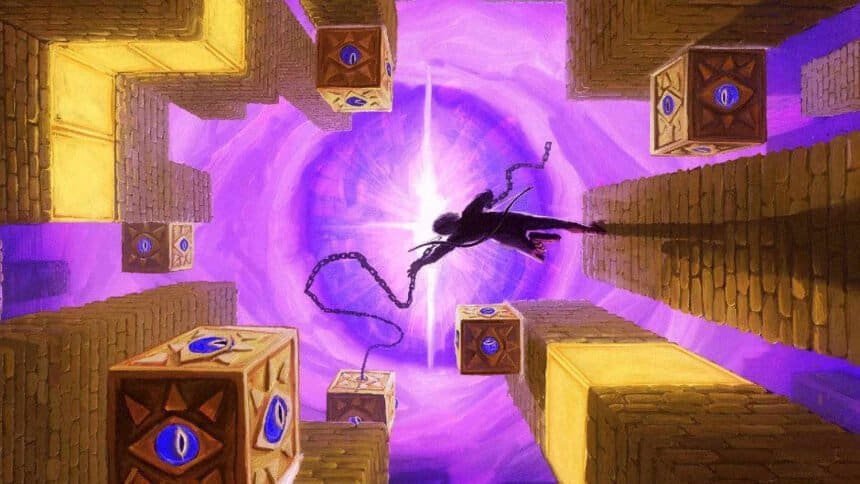
You’re standing on the floor of a stone chamber, bow in hand. You fire an arrow at a box, drag it up the wall, and let go while you’re upside down on the ceiling. The box stays there. Gravity just agreed with you instead of the other way around.
That’s He Who Watches, and it’s the best puzzle game you'll play in 2026.
Big claim, so here’s the context. Portal rewired my brain chemistry in 2007. The first-person puzzle game felt like an impossible magic trick, and almost nothing released since has managed to top it. Nearly 20 years later, one developer pulled it off.

One developer, one very strange building
He Who Watches comes from Bobby Vanden and is published by Draknek and Friends, who know their way around a puzzle game. It takes what made Portal singular and points it at a different idea entirely: perspective.
There’s barely any story. You’re an archer poking around a strange structure full of puzzle chambers, clearing rooms to unlock new areas, hunting glyphs and chasing a god-like being trapped somewhere inside.
Call it a 3D Sokoban game if you want, the term for puzzle games built around pushing boxes. You fire an arrow to grab a box, then move it where it needs to go, onto a switch or out of your way. Get through the exit door of each room. Move boxes, shoot switches, think in space.
Simple, right?
Then the walls become the floor
No. The hook is that you can walk on the walls and the ceiling, and gravity flips to match wherever you’re standing.
Pick up a box on the ground, put it down, it stays on the ground. Fine. Drag that same box to the ceiling and drop it, and it sticks up there.
You can probably guess what kind of puzzles spin out of that. You can probably also guess that sprinting across every surface of a room in first-person will make you a little queasy. Worth it. The trick is executed with precision, and the puzzle design is tight enough to earn the nausea.
You become an engineer and don’t notice it happening
What keeps He Who Watches from being a gimmick is that Vanden doesn’t stop at the gimmick. The gravity flip is a foundation, not a party trick, and he keeps stacking ideas on top of it.
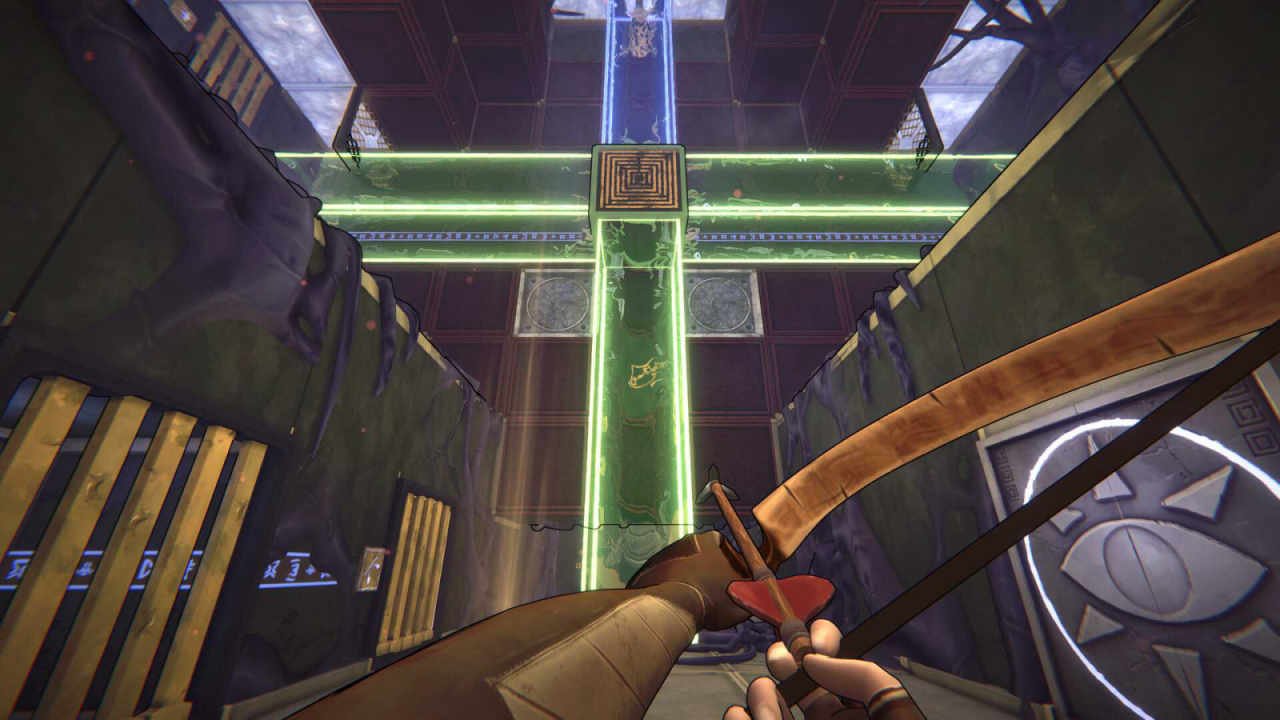
Deep into my playthrough I hit a run of chambers built around transport beams that push boxes along a green, glowing line. Then I worked out that I could jam the beam’s trajectory with a box, which turned the beam into a bridge I could walk across.
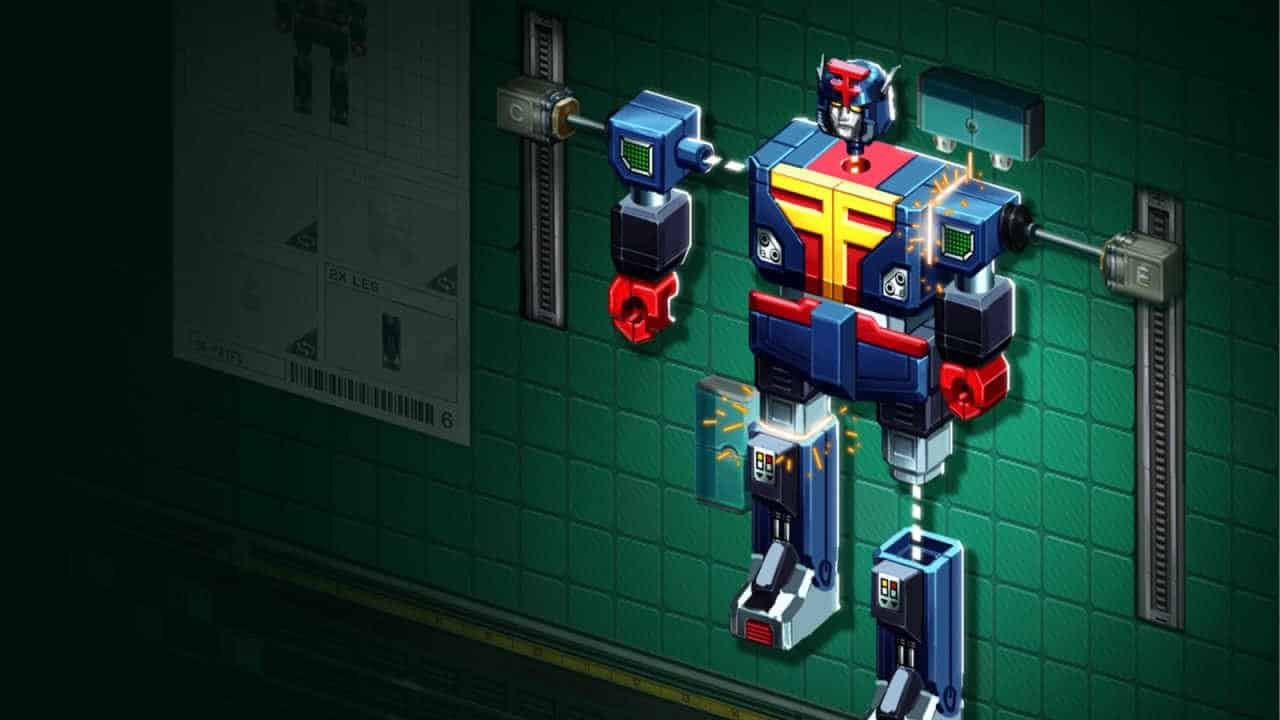
A few puzzles after that, I was effectively programming machines to deliver boxes exactly where I wanted them. The complexity builds so gradually that you’ve become an engineer without noticing.
The hint system other puzzle games should steal
If that sounds like a lot, Vanden thought about that too. Every room has an optional mini-puzzle chamber built to teach you the concept the main puzzle runs on.
Say you’re facing a gap that looks uncrossable. The hint room hands you a small puzzle about getting a box across a gap.
It’s a smart fix for the single worst wall in puzzle games, the moment where you’re stuck because you don’t understand what the game wants from you. That never happens here. You always know the question. The answer is the hard part.

I’m rationing it
I’m still working through it, deliberately slowly, letting each solution land. Even after a puzzle has beaten me for 30 minutes, the answer always feels sensically constructed and fair, and I’m delighted every time.
I tore through Portal the first time I played it. I’ve barely forgiven myself. This one I’m savoring, because a game this creatively euphoric doesn’t come around often, and it’s rich with secrets I haven’t found yet.