

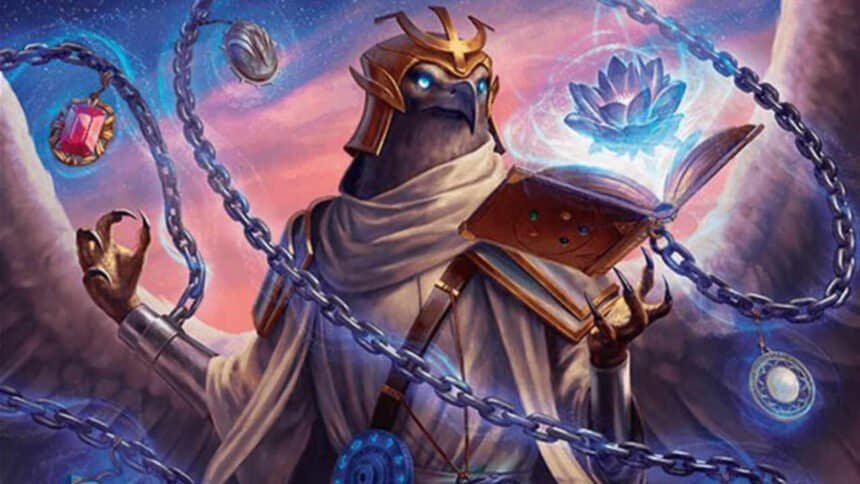
Wizards of the Coast built a card that conjures the Power Nine. Not a nod to them. Not a watered-down homage. Ancestral Recall, Black Lotus, all five Moxen, Timetwister and Time Walk, shuffled into your library by a three-mana blue bird wizard named Oracle of the Alpha.
That card exists because Alchemy exists. And Alchemy is ending.
Wizards has officially set the format’s retirement for early 2027, which closes the book on the most divisive experiment in Magic: The Gathering history. Launched on MTG Arena in 2021, Alchemy promised a digital-native frontier where cards could be rebalanced overnight and mechanics like Conjure, Seek and Perpetual could work without tabletop constraints holding them back.

Purists hated it. Drafting the Power Nine from thin air, permanently altering card stats across zones, directly patching first-player win-rate disparities: none of that is how Magic is supposed to work. But it gave digital players a metagame that moved at the speed of a software patch, and it expanded what a Magic card could even be.
The dedicated queue is sunsetting, though Alchemy’s fingerprints stay on Historic, Timeless and Brawl. So here are the 10 cards that explain the whole strange era.
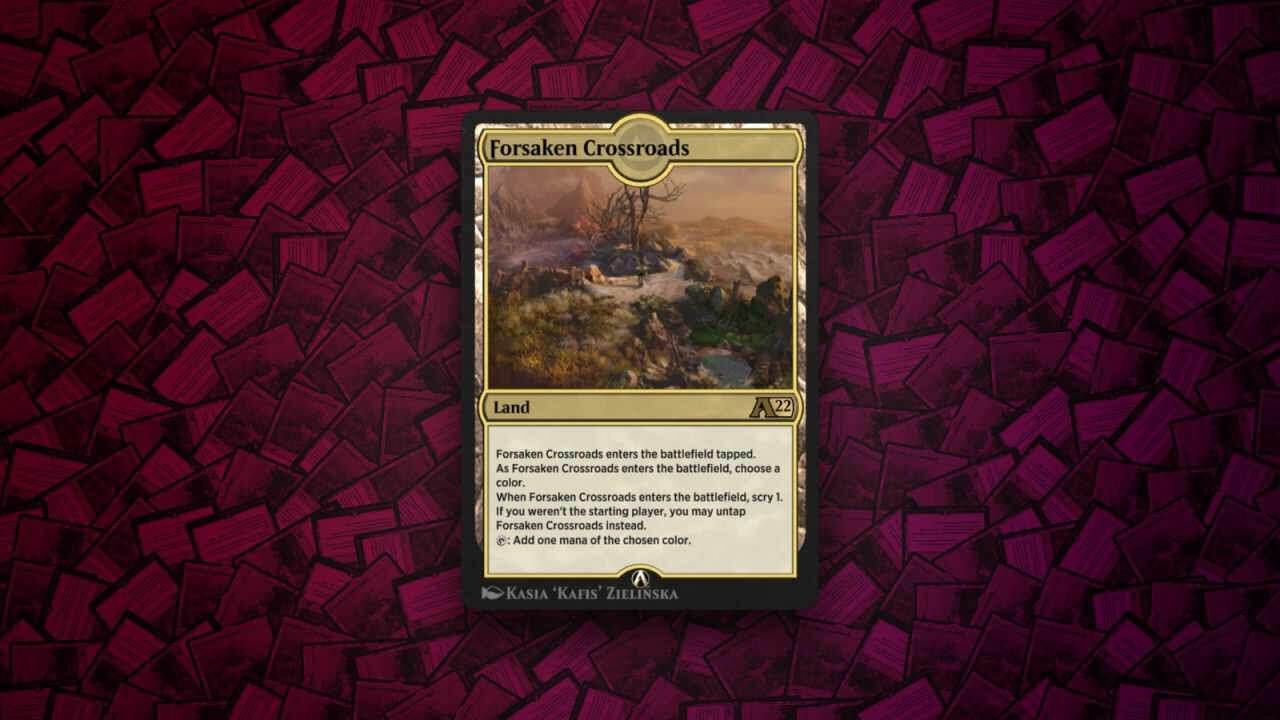
10. The land that admitted Magic has a fairness problem
Forsaken Crossroads is the least interesting card here to look at. It’s also the one that best explains why Alchemy was willing to poke at Magic’s foundations.
It enters tapped, lets you choose a color and scries when it enters. And if you’re not the starting player, you may untap it immediately.
Read that again. This is a land designed specifically to address the disadvantage of going second. Magic cards don’t usually acknowledge the play/draw imbalance so directly. Alchemy just built a card around it instead of pretending it wasn’t there.
Crossroads went on to matter well outside its home format, showing up in Historic, Brawl and other Arena environments. It never wins a game on its own, which is exactly why it earns a spot. Alchemy wasn’t only about printing monsters. Sometimes the interesting idea was the quiet one.
9. A one-drop that got a digital-only upgrade
Symmetry Sage is the first card here that isn’t Alchemy-exclusive, and it’s inseparable from how the format handled rebalancing. Wizards turned the digital version from a 0/2 into a 0/3 and bumped the power it could grant through its Magecraft trigger, which sets a creature’s base power to 3 whenever you cast or copy an instant or sorcery.
Suddenly an already-interesting one-drop was a real threat in blue aggressive decks.
This is the part of Alchemy people underrate. Wizards could build a different version of a card for digital play without touching the physical copy sitting in someone’s binder. The Sage mattered most in Historic, next to cheap wizards that could exploit its power-setting ability.
Not a card invented for the format. A demonstration that digital rebalancing could rewrite an existing card’s competitive identity on the fly.
8. Removal for one mana, with a catch
Take one of Magic’s most powerful effects, attach a suitably weird drawback, and you get Fragment Reality. One white mana, instant speed, exile a nontoken artifact, creature or enchantment. Then, much like Generous Gift, Path to Exile and Chaos Warp, your opponent digs a random creature card with lower mana value out of their library.
The gamble is the whole card. You’re not just removing a permanent, you’re betting the replacement is less scary than what you exiled.
The efficiency was extreme enough that Fragment Reality broke out of Alchemy entirely. Wizards eventually rebalanced it after a particularly nasty interaction with Leyline options produced a consistent Historic and Timeless strategy, restricting it to targeting an opponent’s permanent.
Few cards show off the format’s core promise better: balance around an interaction, then adjust after the fact when the interaction turns ugly.
7. The dragon discount that never goes away
Fearsome Whelp looks like nothing until you watch it work for a few turns. At the beginning of your end step, it permanently reduces the cost of dragon spells in your hand.
Tribal cost reduction is ancient technology, from Dragonspeaker Shaman to the Ur-Dragon. The twist is permanence. Leave the Whelp alive across several turns and the dragons you’ve been hoarding get dramatically cheaper, with the effect snowballing the longer the game runs.
Wizards put Fearsome Whelp among the early rebalances, which tells you how fast that snowball could get out of hand. It’s not the format’s flashiest creature. It is a clean example of Alchemy’s appetite for cards that grow more dangerous the longer they survive.
6. Four mana, two creatures, one very crowded deck
Inquisitor Captain reads harmlessly. In the right shell it’s a four-mana value explosion.
Its ability checks a large pool of cheap creatures across your graveyard, hand and library, then uses Seek to find two that qualify, putting one onto the battlefield and the other back into your library. Load your deck with cheap bodies and it turns that density into instant board presence.
The Captain became the showcase for how Alchemy’s digital mechanics could produce interactions that were harder to predict than ordinary Magic cards. Wizards rebalanced it alongside a batch of other early Alchemy cards, including Town-Razer Tyrant, Goldspan Dragon and the aforementioned Fearsome Whelp.
Even post-nerf, the shape of the thing is fascinating, and it isn’t something you’ll often find in the traditional version of the game.
5. Yes, those Power Nine
Plenty of Alchemy cards are powerful. Almost none of them put the Power Nine in your deck.
Oracle of the Alpha does. The three-mana blue bird wizard enters the battlefield and conjures Ancestral Recall, Black Lotus, the five Moxen, Timetwister and Time Walk, then shuffles them into your library.
It’s ridiculous on purpose. The Power Nine are the most famous and least accessible cards Magic has ever printed, and Alchemy decided that in a digital environment there was no reason you couldn’t occasionally play with them.
Oracle isn’t the most efficient creature here, and that misses the point. Nothing captures the freedom of Arena’s digital card pool more completely. It could never function in sanctioned tabletop Magic, which is precisely the argument for its place on this list.
4. A tiny portal into Magic’s back catalog
Key to the Archive might be the best advertisement the spellbook mechanic ever got. At four mana it’s already a useful source of colored mana, but the draw is the curated menu it offers when it enters the battlefield.
Demonic Tutor. Time Warp. Counterspell. Day of Judgment. Lightning Bolt.
You don’t know which one you’re getting, so it never plays like a traditional tutor. Every activation still hands you a spell capable of changing the entire texture of a game.
Less an artifact than a door.
3. The land-destruction dragon Wizards kept sanding down
Town-Razer Tyrant showed early on how far Alchemy could stretch Magic’s design boundaries. The four-mana dragon targets an opponent’s nonbasic land when it enters and converts it into a ticking time bomb: sacrifice the land or take the damage.
Nasty on its own. Genuinely notorious against multicolor decks leaning hard on their mana bases.
Wizards rebalanced the aptly named Tyrant more than once, eventually limiting the ability to nonbasic lands and moving the damage trigger from the opponent’s upkeep to the end step. That repair history is what makes it such a good snapshot of the early format.
Print that card on cardboard and you live with it. Print it digitally and you can keep turning the dial.
2. The clock that never stops ticking
Rusko, Clockmaker is Alchemy distilled into one strange, deeply annoying package.
The four-mana 3/3 doesn’t just generate value on entry. It conjures a Midnight Clock and keeps converting noncreature spells into more resources. Every noncreature cast hands you another Clock trigger, drains your opponent and raises your own life total.
Try racing that. Try grinding it out. Both are miserable.
Rusko is also the clearest case for why digital-only Magic feels different from the tabletop game. The card is built on conjuring and repeatable digital effects that would be awkward or outright impossible to execute physically. The Clockmaker got its reputation in Historic and Brawl, but its roots are in Alchemy, and it proves the format was happy to fit an entire engine inside a single creature.
1. The card that proved Alchemy could get away from Wizards
Crucias is the easiest card here to point at when you’re explaining how Alchemy went sideways.
The four-mana Grixis creature didn’t need help taking over a game. A solid 3/3 body, a triggered ability that could generate a Treasure, and an unusually strong form of card selection stapled on top.
The value wasn’t the problem. The choice was. Crucias let you decide what kind of value you needed at the exact moment you needed it, converting excess cards in hand into whatever resource your deck was short on. Against a normal midrange game plan, that’s a nightmare.
Wizards eventually stepped in and cut Crucias from a 3/3 to a 3/1, after black-red midrange rode it into one of Alchemy’s best-performing strategies.
That’s the format in miniature. Build something nobody could print on cardboard, watch it warp the metagame within weeks, then reach into the code and shave a point of toughness off it. In early 2027 that ability goes away, and the Oracle stops handing out Black Lotuses to anyone who asks.