

By 2035, U.S. data centers are expected to burn more natural gas than Germany and Japan combined. That’s BloombergNEF’s projection, and it’s almost double what the same firm predicted nine months ago.
Numbers like that land differently depending on where you live. In Grays Ferry, Southwest Philadelphia, they land on a neighborhood that already spent decades downwind of the East Coast’s largest oil refinery.
Shawmar Pitts grew up next to it. The plant shut down after an explosion in 2019, and for most of his life he didn’t connect his neighbors’ illnesses to the thing sitting at the end of the block.

That changed in 2018, when the environmental justice group Philly Thrive set up a table in his neighborhood to talk about a proposed refinery expansion.
The list on the table
“I read the information they had on the table about how living near the refinery affects you, and I’m looking at all the sicknesses on this paper, and I’m like, ‘My mother has this, my sister has that, my next-door neighbor suffers from this’ — every house, someone has something on that list,” Pitts told us. “From that point, I was all the way in.”
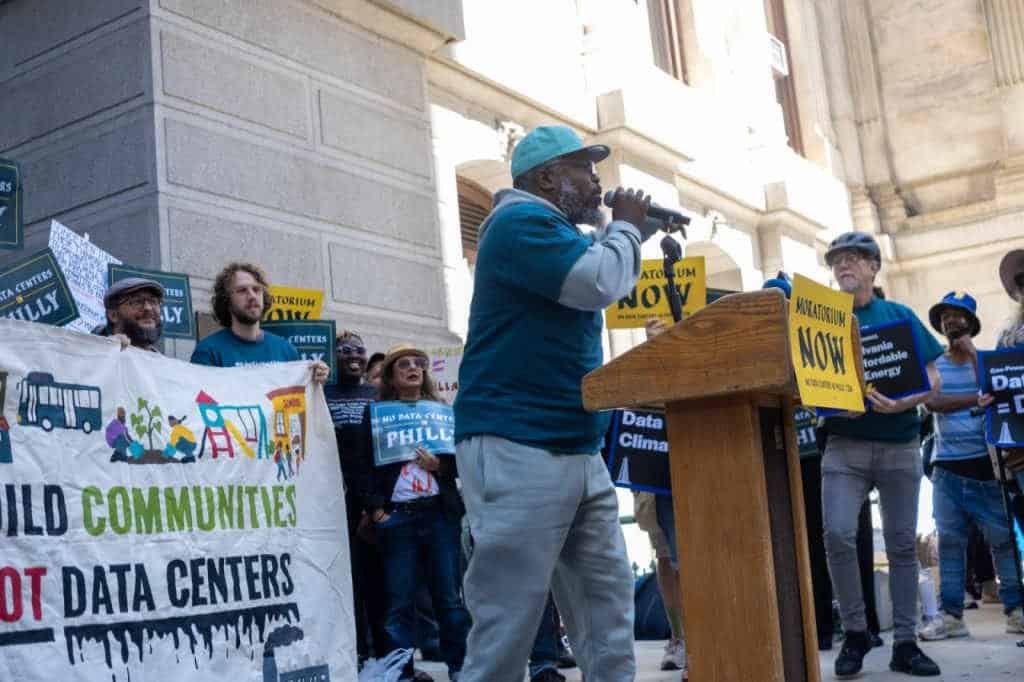
He’s now managing co-director of that same organization, and he’s among those pushing for a data center moratorium in Philadelphia.
Here’s the part that makes this unusual. There are no formal construction proposals yet. City officials have identified two potential sites, one in Northeast Philadelphia and one in Pitts’ own Grays Ferry.
The opposition showed up before the buildings did.
The pitch isn’t landing
Data center companies and their customers are selling jobs and economic growth. That pitch hasn’t convinced a majority of Americans, who oppose data center construction in their area, usually over environmental and energy concerns.
Pushback has surfaced across the country, especially in cities and towns working with finite resources. But it moves fastest in places where heavy industry left a mark people can still point to.
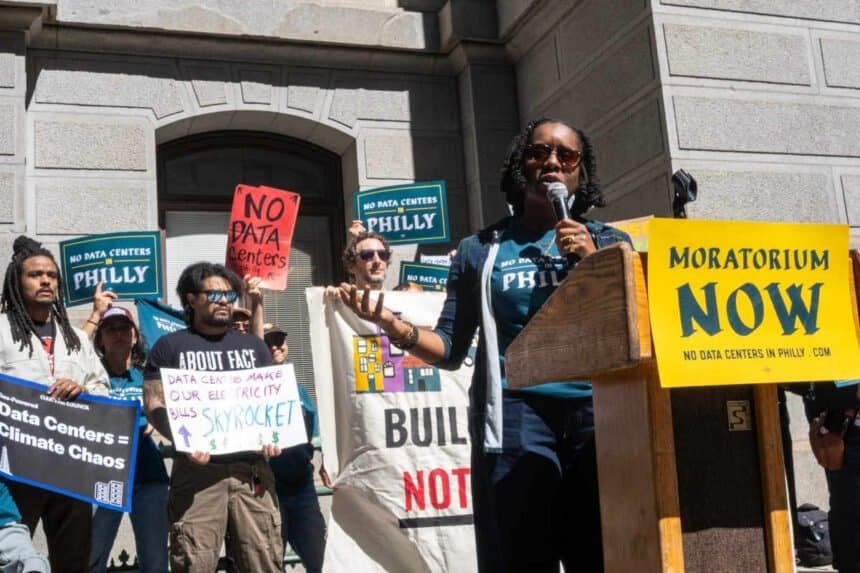
“We don’t want data centers,” Philly Thrive board president Sonya Sanders said at a rally Monday at Philadelphia’s City Hall. “We don’t want the pollution, we don’t want the noise, and we know they’re not going to bring us more jobs.”

Sanders’ husband, also a Grays Ferry resident, died of a rare bone cancer in 2020. He didn’t smoke or drink, she said, and she believes refinery emissions caused his illness.
“In my eyes, they killed him,” Sanders said at the rally. “The pollution killed him. I believe he would be here today if he wasn’t silently murdered, because it was the pursuit of profit that killed him.”
A data center isn’t a refinery. That’s not the whole argument
Let’s be fair about the comparison, because the activists’ opponents will be. A Philadelphia data center probably won’t hit the neighborhood as hard as the Philadelphia Energy Solutions refinery did. That facility processed up to 335,000 barrels of crude oil a day.
But the race to dominate AI has pushed the energy math into territory nobody was modeling a year ago.
Natural gas burns cleaner than oil. It isn’t clean. Burning one cubic foot releases the equivalent of 60 grams of carbon dioxide, and the extra data center demand is expected to generate an additional 1 million metric tons of greenhouse gas pollution every day. That’s roughly 12% of all present-day U.S. greenhouse gas emissions.
Harvard University researchers found in 2021 that fossil fuel air pollution is responsible for one in five deaths worldwide. That figure was calculated before any of this buildout started.
The diesel engines nobody talks about
The backup power is where the local argument gets concrete, and it’s the detail most coverage skips.
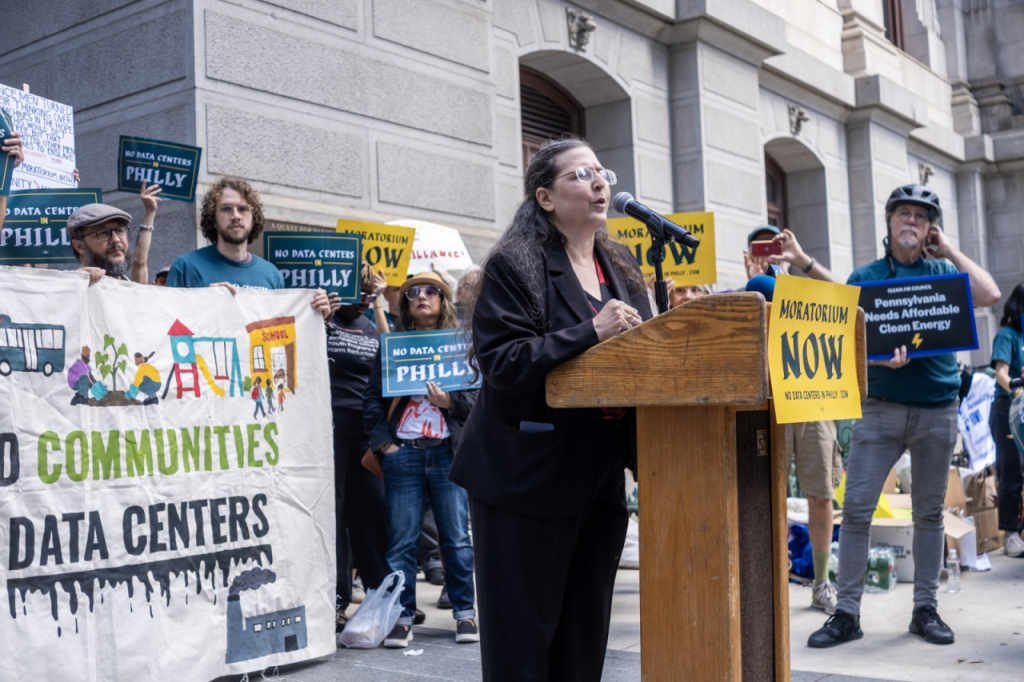
“A typical data center planned in Pennsylvania has hundreds of diesel engines that spew air pollution, and even if they’re supposedly reserved for emergencies, the government has already said that the data center should use those rather than drawing from an overstressed electrical grid during some heat waves,” Clean Air Council attorney Annie Fox said at the rally. “We can expect that to get more frequent… Fossil fuel-hungry data centers will worsen climate change, making those heatwaves more frequent and severe.”
Read that twice. The emergency generators aren’t strictly for emergencies, and the thing that triggers them is a problem the facilities help create.
Officials are starting to move
In New York, Governor Kathy Hochul signed an executive order that temporarily blocks the state from approving new permits for large projects.
“Progress shouldn’t arrive with a higher utility bill, deleted water supply, or noise pollution,” Hochul said at a press conference. “These data centers can only be built, should only be built in places that want them.”
Denver, Indianapolis, Asheville, Charlotte and Reno have all approved data center moratoriums. Most of them aren’t permanent bans. They’re pauses, meant to buy officials time to figure out what these facilities actually do to a city before approving one.

What residents say they’re worried about
The concerns at the Philadelphia rally went past emissions.
“I’m worried about pollution,” Philadelphia resident Donna Greenberg told us. “I’m worried about surveillance and the fact that they’re going to have access to information they have no business knowing, and I’m concerned that they’re going to be using water and electricity that takes away from the people and the neighborhoods who need it.”
More than 100 people turned out for the kickoff rally of the No Data Centers in Philly campaign on Monday. They chanted loud enough, they hoped, for council members to hear it from inside City Hall.
“I just think that our community standing up and fighting back is tremendous,” Pitts said. “It takes a lot of effort and a lot of people.”
If you want to know where the next fight over AI infrastructure lands, don’t watch the permit filings. Watch the neighborhoods that already know what a smokestack costs them, and notice that in Philadelphia the campaign launched against two sites that exist only on a map.