
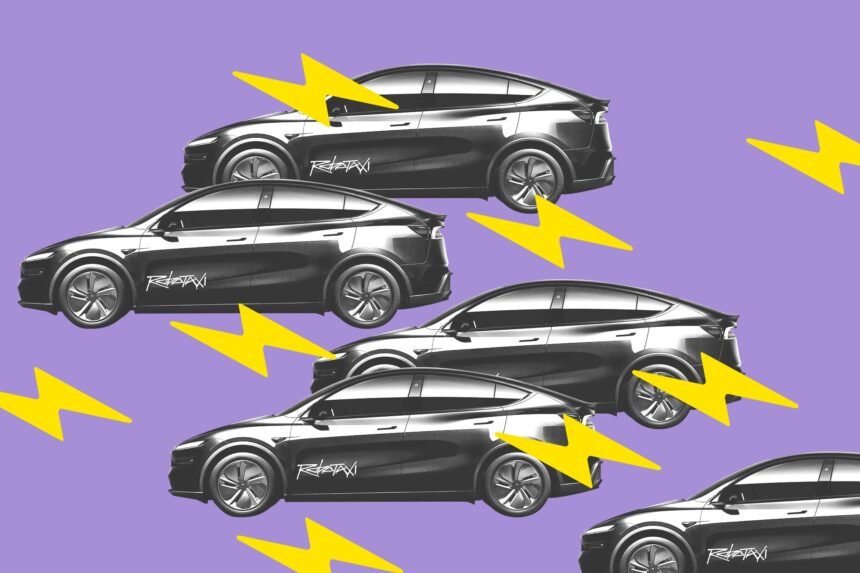
Tesla says its robotaxi program is growing. The numbers it released this week say something closer to the opposite.
On an earnings call yesterday, CEO Elon Musk tried to sell investors on a service that’s adding cities, adding miles and putting more people inside unsupervised cars. He sounded oddly restrained doing it.
“We’re going as fast as humanly possible in scaling Robotaxi,” Musk said, “while trying to ensure that we do not harm anyone at all and ideally do not even run over a pet.”

That last line matters more than it sounds. Here’s the gap between the pitch and the reality: mileage is basically flat, the fleet appears to be shrinking, and the safety record is still an open question no matter how many times the company says “zero notable incidents.”
380,000 miles sounds big until you see Waymo’s week
Ashok Elluswamy, Tesla’s head of AI, said the company’s unsupervised robotaxis have driven 380,000 miles across six cities in two states. Musk put the growth at 10 percent a week in miles driven.
Now the comparison Tesla would rather you skip. Waymo, which pairs cameras with lidar and radar as redundant sensors, drives around four million miles a week. Tesla’s total, a full year into its robotaxi program, comes in under 10 percent of that weekly figure.
Investors noticed. BNP Paribas Equity Research senior analyst James Picariello called it “an alarming decline” in a research note to clients.
Elluswamy took a shot at lidar anyway
The sensor argument is Tesla’s whole personality, so of course it came up. Elluswamy couldn’t resist a jab at rivals who lean on lidar instead of Tesla’s camera-only setup.
“Historically, the so-called experts have always claimed that you need lidars, radars, HD maps, and the entire kitchen sink to drive safely,” he said. “Here we show that such is not true. You can have safe, comfortable, and affordable autonomy with just cameras. This record should be a huge validation of Tesla’s entire AI approach.”
The problem is that the record he’s pointing to is the same one showing flat mileage and a thinning fleet. Validation is a strong word for that.
The fleet you can actually count
Tesla runs a mix of supervised and unsupervised vehicles, and the ratio keeps moving. The crowdsourced Robotaxi Tracker puts the current unsupervised count at 16 vehicles in Austin, four in Dallas and one in Houston.
That’s 21 cars carrying a program Musk describes as scaling as fast as humanly possible.
Someone on the call asked the obvious question: why sprinkle a handful of cars across new cities instead of flooding Austin, where the service launched a year ago?
“The reason we have been expanding across different cities, instead of just doubling down on a single city, is that we want to make sure that our stack is a very general one,” Elluswamy said. “It is a general one. We just want to like, you know, both prove to ourselves and to other folks that it is working across a lot of different cities without too much effort per city.”
New Jersey could close the door
State rules are the other brake. New Jersey is weighing a bill that would effectively ban robotaxis that don’t carry multiple sensors, the exact radar-and-lidar stack Tesla refuses to use.
Morgan Stanley analyst Andrew Percoco raised it directly, noting “there seems to be some evolving regulations at the state level, potentially around sensor requirements.”
Tesla’s vice president of vehicle engineering Lars Morvay didn’t pretend otherwise. “Obviously the stuff in New Jersey, you know, is a little bit disheartening,” he said.
A patchwork of sensor mandates shrinks the market Tesla can serve. It also undercuts the story of a general-purpose service that drives anywhere, under any conditions.
The pet line was aimed at Waymo
Musk’s crack about not running over anyone’s pet wasn’t random. It read as a dig at Waymo, which has hit and killed a number of animals over the past several years.
Tesla’s own record is harder to read, and that’s partly by design. The company redacts many of the important details from its robotaxi crash reports, so outsiders don’t get much to work with.
What we do have: the Robotaxi Tracker counts roughly 18 incidents involving the fleet, 56 percent of them the fault of another driver. Tesla’s Full Self-Driving is also under investigation by the National Highway Traffic Safety Administration, with a possible recall down the line.
One more detail worth sitting with. Tesla’s robotaxis are running version 15 of FSD. The cars in customers’ driveways are on version 14.3.6.
What to watch instead of the pitch
Tesla is asking investors, supporters and customers to look past all of this and trust that the program is growing. The company’s own numbers keep arguing back.
If you want to know whether the robotaxi story is real, ignore the city count and the weekly-growth percentages. Watch two things: whether that 21-car unsupervised fleet gets meaningfully bigger, and whether New Jersey’s bill becomes the template other states copy. Those move before the press releases do.