
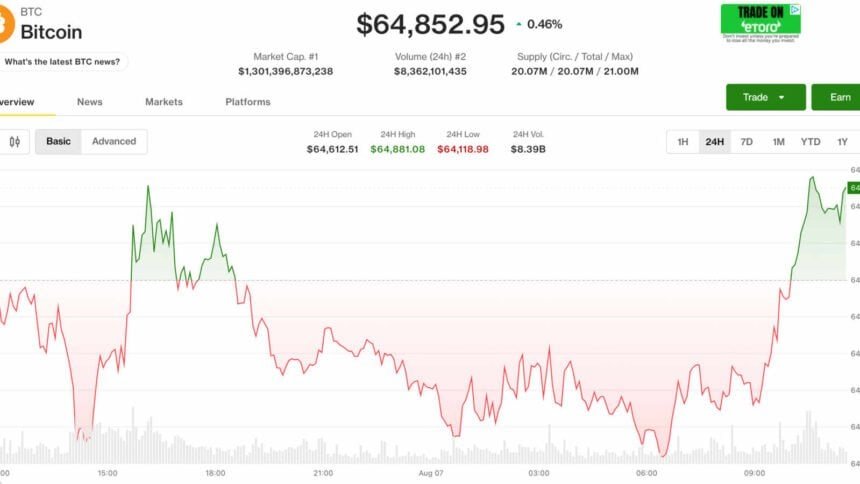
Bitcoin sat at roughly $64,700 on Friday, and the number barely moved all day. Twenty-four hours of trading, close to nothing to show for it.
That flatness is the story. Every macro input pointing at crypto right now got worse this week, and bitcoin didn't break in either direction.
The broader CoinDesk 20 index (CD20) was down 0.2% over the same period. A rounding error, effectively.

Oil is the input nobody’s pricing in yet
Brent crude pushed past $83 a barrel after Yemen’s Iran-linked Houthis attacked Saudi Arabia. That’s an escalation on top of an already tense region, and it’s the kind of headline that usually drags risk assets around by the collar.
It didn’t. Not on Friday, anyway.
But the transmission mechanism here isn’t same-day. Sustained higher oil feeds inflation, and inflation is what determines whether the Fed cuts.
The 10-year is the number to watch
Treasury yields corrected slightly but the 10-year note is still sitting at 4.67%. That’s the level where Fidelity’s Director of Global Macro Jurrien Timmer said “history suggests that nothing good happens.”
Timmer isn’t talking about crypto specifically. He doesn’t need to.
Elevated yields tighten financial conditions across the board. Combine that with oil-driven inflation pressure and you get a market that starts pricing out near-term rate cuts, which is exactly the environment bitcoin and other risk assets struggle in.
Gold is doing what bitcoin isn’t
Gold climbed 1.5% to $4,300 per ounce, extending its recovery as investors rotated toward safety.
Worth sitting with that for a second. Same uncertainty, same headlines, two assets that get pitched to the same audience as a hedge against the same problems. One moved 1.5%. The other moved a fraction of a percent.
If your thesis is that bitcoin trades as digital gold, Friday was not a supporting data point.
Zcash puts a real test on the calendar
Away from the macro noise, Zcash’s Tachyon upgrade is the thing worth tracking. It aims to scale shielded payments and improve quantum readiness.
It also functions as a stress test of whether the project’s funding, security and governance can hold. That last part is the harder question, and it’s the one that doesn’t get answered by a benchmark.
Why the Tachyon question is bigger than Zcash
Plenty of chains ship upgrades. Fewer of them use one to find out whether their funding model survives contact with the work.
Shielded payments at scale and post-quantum preparation are both expensive, slow problems. Governance is what decides whether you can keep paying for them.
What to actually do with this
Don’t read Friday’s flat tape as stability. Read it as bitcoin waiting.
The two variables that matter are Brent holding above $83 and the 10-year staying near 4.67%. If both persist, rate cut expectations compress and the pressure on risk assets shows up with a lag, not on the day of the headline.
Set your alerts on the 10-year, not on the bitcoin chart. The bond market is going to tell you first.