
In Brief:
- Pixion Games opened guild registration for Fableborne (official site) Season 5, which begins Aug. 12.
- The season adds Equipment and a new upgrade resource called Glyphs, and gives every worker a health bar tied to Glyph and Trophy output.
- Season 4’s guild prize pool hit 1.66 million POWER, funded by up to 70% of webshop revenue.
Pixion Games opened guild registration for Fableborne Season 5, with the competitive window starting Aug. 12.
Signups run through the guilds portal at fableborne.com/guilds, where players can join an existing guild or create one and take the leader slot. “The fight for $POWER is bigger, better and more competitive than ever!” the studio said in the post announcing the season.

Fableborne Season 5 is here!
The fight for $POWER is bigger, better and more competitive than ever!
The battle begins August 12th
Guild signups are now OPEN on https://fableborne.com/guilds
Create your account now and prepare for battle!@FableborneView on X ↗
What Season 5 changes
Season 5 introduces Equipment along with Glyphs, a resource needed for item upgrades. Every worker now carries a health bar, and worker condition feeds directly into Glyph and Trophy production. Workers become available through campaign levels and quests, player level increases and Worker Shards.
Item stats cover Health Regen, Movement Speed, Added Damage, Critical Damage and Damage Reduction. Pixion has said each item opens a different playstyle.
Two Vanguard units arrive with the season. Guard is a tanky close-combat unit whose Guard Stance counters mistimed attacks. Blob can’t be taken down in one shot and splits into smaller blobs when defeated, forcing players to manage timing and area damage.
How guild seasons pay out
Guilds debuted in Season 4 and cap out at 50 players. Members earn Guild Valor through events and spend it on GG Chests, which produce Guild Glory. That Glory counts toward both a solo leaderboard rank and the guild’s total score, and the two boards carry separate reward sets so smaller guilds can still place.
During Season 4's guild window, up to 70% of webshop revenue, excluding Power Chests, went into the $POWER prize pool. The pool scaled with player spending and finished at 1.66 million POWER. Guild leaders take a cut of what their members earn.
That guild season ran 17 days, from Dec. 8 to Dec. 24, inside a Season 4 that ended Jan. 5. Pixion also ran a Guild Surge Program beforehand, paying successful applicants up to $25,000 and requiring at least 10 members plus prior guild management experience in web2 or web3 games.
Token and staking
The $POWER token generation event went live Dec. 5, debuting on Binance Alpha with an airdrop claimable using Alpha Points. Total supply is 1 billion, with 210 million circulating at launch. The allocation splits 37.2% community, 28% ecosystem, 16.15% investors, 9.23% team, 5% liquidity and 4.42% advisers.
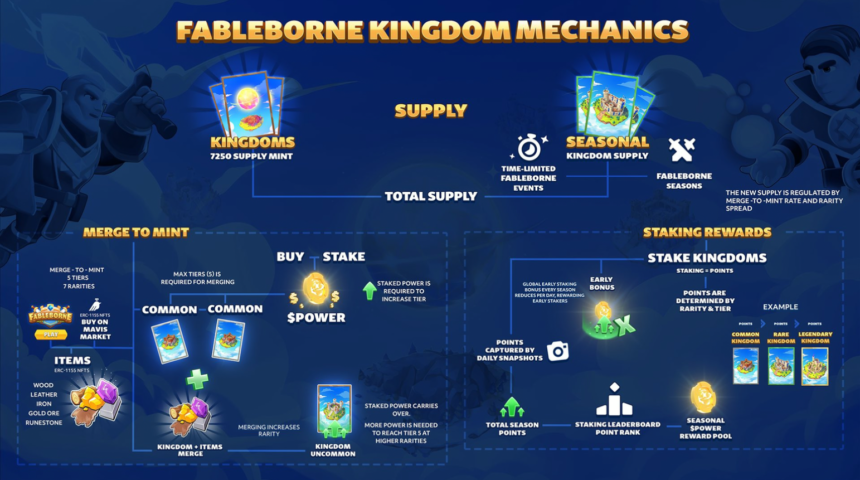
Staking Season 3 opened July 23 at 2 p.m. UTC with 2,200,200 POWER in rewards. Staking runs through the Fableborne Kingdoms NFT collection, which holds 4% of total supply for rewards. Points snapshot once daily at 1 p.m. UTC, and players can unstake and restake between snapshots without penalty.
Season 2 carried a 2.2 million POWER pool. It drew more than double Season 1’s staked POWER and participant count after staking expanded to Ethereum and Ronin and loyalty bonuses were added.
Background
Fableborne went into global open beta Dec. 2 out of London, after earlier seasons pulled more than 380,000 players, a peak of 108,000 daily active users and $21.5 million in NFT presale revenue. Pixion has since put beta player count above 400,000. Weekly retention ran between 25% and 51%, across more than 2.4 million sessions averaging 32 minutes.
Kam Punia, founder and CEO of Pixion Games, called the beta the studio’s “most significant step forward.” The studio was founded in 2017 by developers from Konami, Garena, Gala Games, Square Enix, Sony, Wargaming, Pixonic, Ubisoft and NCSOFT.
Pixion raised $12.4 million ahead of the token launch, and BITKRAFT Ventures put in $3 million in February. Earlier backers include Delphi Digital, Spartan VC, Mechanism Capital and L1D.
POWER peaked at $2.40 on March 3, capping an 872.5% 30-day run, then lost 90.25% of its value after a temporary pause on the Ronin Bridge opened a gap between DEX and CEX pricing. By April it traded near $0.078 at roughly a $16 million market cap, with 72.8% of supply still locked.