
In Brief:
- Kepithor Studios opened a new ENJ Excavators season, wiping the leaderboard and resetting every player’s gems and upgrades to zero.
- The top 600 finishers each week split ENJ from a pool funded by an Enjin validator node the studio runs, which Kepithor said brings in upwards of 15,000 ENJ a month.
- Only NFTs carry across the reset, so Goblin holders keep their mining boosts while upgrades bought with ENJ expire.
Kepithor Studios has reset the ENJ Excavators mine and started a new season, putting every player back at zero gems and stripping out every upgrade bought during the last cycle.
The studio announced the reset on X, telling players to “chase your share of ENJ before the leaderboard closes.”

The mine has reset and everyone starts from zero.
A new Enj Excavators season is live.
Turn a few taps into a goblin-powered operation and chase your share of ENJ before the leaderboard closes.
#MobileGaming #IdleGames #enjin@KepithorView on X ↗
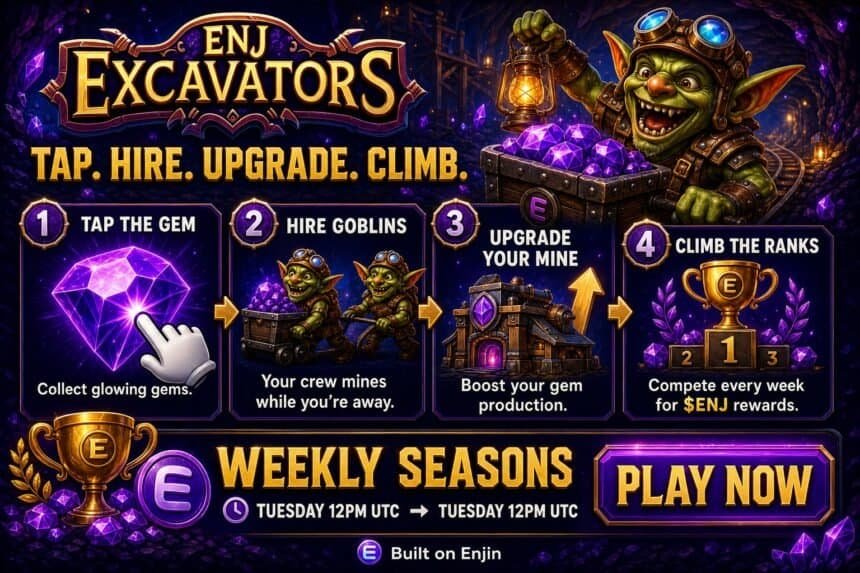
The wipe is routine. ENJ Excavators runs on a weekly cycle, and the board clears every Tuesday at 12:00 UTC, with prizes paid out in ENJ shortly afterward to the top 600 finishers.
What survives a reset
Almost nothing. The leaderboard, gem balances and equipment upgrades all go, including upgrades players paid ENJ for. Any purchase made with ENJ lasts only until the season ends.
NFTs are the exception. Goblin NFTs from NFT.io carry between seasons and apply a global production boost ranging from 1% to 12%, which is why holders start each new mine ahead of everyone else. Base Goblin Cart NFTs trade around 25 ENJ on NFT.io.
All 15 Enjin Multiverse NFTs, spread across roughly 21,000 wallets, have utility in the game and boost the effectiveness of in-game boosters. Each upgrade in the game is named after one of them.
One other thing persists. Watching an ad grants a 0.1% mining boost that carries into the next season at half strength, then halves again: 0.05%, then 0.025%, and so on.
Where the prize money comes from
Kepithor bankrolls the pool with an Enjin validator node it operates. By the studio’s account, node rewards have reliably exceeded 15,000 ENJ every month.
Because only 2.5% of the pot is paid out weekly while validator income keeps arriving, the pool grows rather than drains. Kepithor’s own guide put the total at almost 80,000 ENJ, with a running figure visible through the crypto menu on kepithor.com.
The game’s account said in a recent post that more than 14,000 ENJ had been added to the main prize pool, lifting weekly pools including the season then in progress.
The studio also takes a 10% creator royalty on its NFT collection, earning a cut of every trade on NFT.io and other Enjin marketplaces.
How the season is played
Players tap to gather gems, then spend them on workers that mine automatically and on upgrades that raise output. Ranking is by gem balance, which creates the season’s central tension: gems spent on equipment are gems subtracted from your leaderboard total.
Everyone who plays and spends some of the gems they mine earns a prize, which the studio says takes about a minute of gameplay. Placement determines how much.
Onboarding runs through Enjin’s Managed Wallet. A new player needs only an email, no seed phrase, and can move winnings to a self-custody Enjin wallet later.
Background
Kepithor joined Enjin’s Early Adopter Program in November 2018. Its first title, Kingdom Karnage, used the early Enjin Platform on Ethereum between 2018 and 2020, and was followed by Kingdom Karnage: Heroes and Kingdom Karnage: Clicker.
The studio returned to the Enjin ecosystem in February 2024 with ENJ Excavators, and the game hit Google Play on March 5, 2024, promoted as a $12,500 launch. Prize pools started at 5,000 ENJ for the first five weeks.
Integration was fast. Kepithor said it connected to Enjin Blockchain within two hours and wrote a tutorial for Enjin’s documentation so other developers could do the same. Founder Nick Franklin said the studio was “very impressed with the Enjin Blockchain’s usability.”
Kepithor splits its work across two chains. ENJ Excavators uses Enjin NFTs and pays in ENJ, while the studio’s other games run on its KEPI token on BNB Chain. Franklin said “the beauty” is that “they all work together.”
The game has drawn close to 2,000 players and, according to the studio, turned profitable.
“We’re transparent about what we’re earning and how it’s distributed,” Franklin said.