

In Brief:
- Ronin said the Moku team built a rogue-lite in 10 days.
- The game runs on goo gathered between runs, spent across five weapons, three upgrade trees, 10 perks and 15 collectible slimes.
- Moku has raised $5.35 million from Sky Mavis, a16z Games’ Speedrun and others, and opened Grand Arena (official site) Season One in February with a $1 million starting prize pool.
Moku built a rogue-lite in 10 days, Ronin said in a post on X promoting the game.
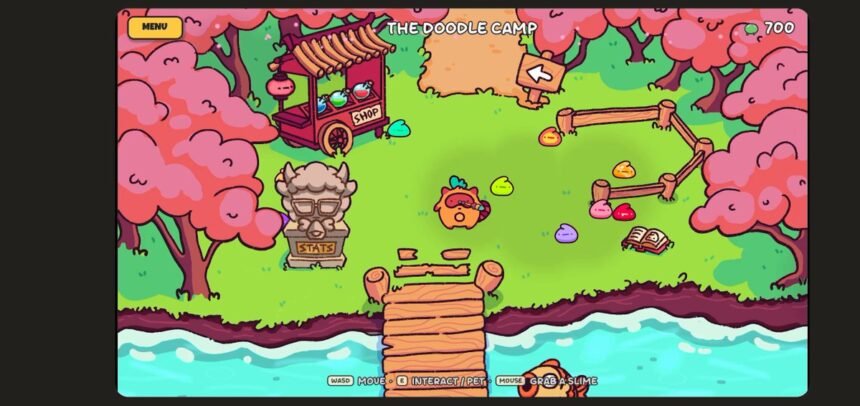
The loop turns on goo, a resource players gather between runs and spend on upgrades. Five weapons sit across three upgrade trees. Ten perks and 15 collectible slimes modify a loadout further.

The Moku team built this rogue-lite in only 10 days!
• Rogue-lite loop: Gather goo between runs to upgrade 5 weapons across 3 upgrade trees, plus 10 perks and 15 collectible slimes that further modify your loadout.
• Content: Randomly generated floors, 12 enemy types, 3 bosses@RoninView on X ↗
Floors are randomly generated. Ronin counted 12 enemy types and three bosses.
“The Moku team built this rogue-lite in only 10 days!” Ronin said.
The post didn’t name the game, give a release date or say what platform it runs on.
Who Moku is
Moku is a Ronin studio and questing platform that started as QU3ST before relaunching under its current name. It raised $5.35 million from Sky Mavis, a16z Games’ Speedrun, Framework Ventures, 32-bit Ventures and more than a dozen angel investors.
Its Moki Genesis collection runs to 8,888 NFTs. Holders get first access to playtests and events plus bonus points on the questing platform. The Moki tanuki IP has also appeared in The Machines Arena (official site) and Nifty Island (official site), and Moku runs a creator program with more than 3,000 participants.
The Grand Arena pivot
Moku’s current flagship is Grand Arena, an AI fantasy contest game in which Mokis compete as autonomous athletes. Season One opened Feb. 20 with a $1 million starting prize pool across a 12-week season running to mid-May, and the pool scales with ecosystem activity and participation.
Players submit five-card lineups into free or paid contests using Gems. The top 20% of participants take higher leaderboard rewards and the top 50% split a fixed pool. Payouts are distributed through Moku XP, earned by entering contests, training Mokis, collecting cards and climbing the seasonal leaderboard.
A four-week preseason came first, starting in November 2025 after an over-allocated presale in October. Training progress and mXP carried into Season One. Ronin announced a Moku Guild Boost Program in January with $50,000 in guild grants ahead of the season.
That launch marked a pivot for the studio, which phased out older platforms to concentrate on the AI fantasy ecosystem.
Earlier games
Super Battle Moki, an async autobattler in which players field creatures called tamakins, went into closed beta from late March to early April 2025, restricted to Moki Genesis holders. Testers tried to reach 10 wins before losing four lives.
Moku has also shipped smaller titles, among them Double or Nothing and Moki Pochi, a game about combining matching items to create new ones. Moki Pochi logged 257,000 plays.