
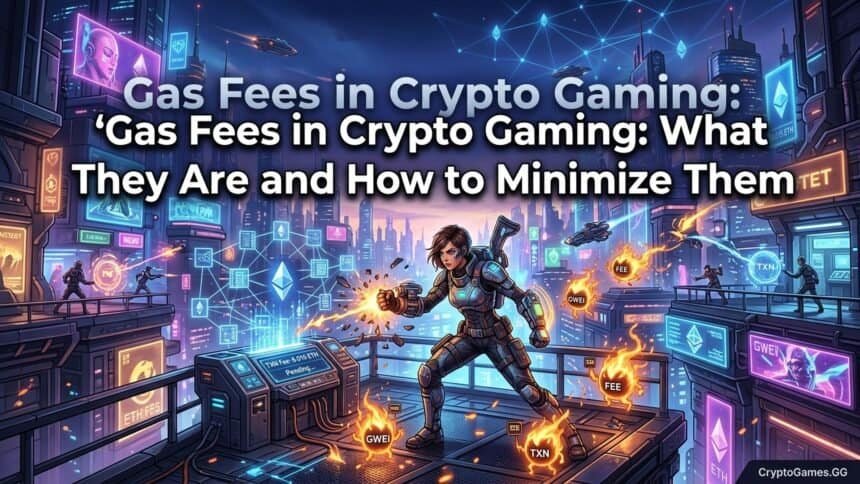
Gas fees are the single biggest friction point in blockchain gaming — the tax every on-chain transaction pays to network validators. They’re why your Gods Unchained card forge costs more during a bull run, why some players avoided Ethereum mainnet entirely, and why zero-fee chains like Immutable X became so attractive for gaming. Understanding gas fees in gaming — what causes them, which games eliminate them, and how to minimise them when they’re unavoidable — removes the most common source of unexpected cost in crypto gaming.
What Are Gas Fees?
Gas fees are the cost of executing computation on a blockchain. Every transaction — minting an NFT, trading a card, claiming a reward, approving a smart contract — requires the network’s validators to process that transaction and include it in a block. Validators don’t do this for free. The gas fee is the payment they receive for that work.
On Ethereum, fees are denominated in “gwei” (one billionth of one ETH). Simple transactions like token transfers use less gas than complex smart contract interactions. Fee = gas units consumed × gas price (gwei per unit). During congested periods, users bid higher gas prices to have their transactions prioritised — this is why fees spike during NFT mints and token launches when thousands of transactions compete simultaneously.

Gas fees are paid in the blockchain’s native currency. Ethereum gas is paid in ETH. Ronin gas is paid in RON. Polygon gas is paid in POL (formerly MATIC). This means gaming on any chain requires holding a small amount of the chain’s native token for fees, even if you’re primarily using game-specific tokens and NFTs.
Gas Fees by Gaming Chain: The Full Comparison
Ethereum mainnet: The highest-fee environment in blockchain gaming. During peak periods (bull markets, major mints), simple transactions can cost $20–100+. Gaming directly on Ethereum mainnet is economically impractical for micro-transactions. Ethereum gaming has almost entirely migrated to layer-2 solutions for this reason.
Immutable X (zkEVM): Near-zero fees for most in-game transactions. Immutable X’s ZK-rollup architecture batches thousands of transactions, verifies them with a zero-knowledge proof, and settles them on Ethereum mainnet as a single transaction. The cost efficiency is orders of magnitude better than mainnet. Gods Unchained card forges, RavenQuest item trades, and Guild of Guardians runs all happen with sub-cent fees. This is the gold standard for gaming fees. See What Is Immutable X? The Blockchain Built for Gaming for the full technical explanation.
Ronin: Minimal fees (~$0.001 per transaction). Ronin was built specifically for Axie Infinity’s transaction volume — thousands of daily scholarship players making multiple transactions each. The chain subsidises transactions through its own validator economics, keeping fees functionally free for typical gaming activity.
Solana: Extremely low fees ($0.00001–0.001 per transaction). Solana’s high throughput and fee structure make it one of the cheapest chains for gaming. Star Atlas, Aurory, and other Solana games benefit from essentially invisible fees at current transaction volumes.
Polygon PoS: Low fees ($0.001–0.01 per transaction). Significantly cheaper than Ethereum mainnet but not as consistently low as Immutable X or Ronin during high-traffic periods.
opBNB: Sub-cent fees. As a Binance layer-2, opBNB provides fee economics comparable to Immutable X. World of Dypians’ 3.7 million monthly players are economically viable on opBNB precisely because each transaction costs fractions of a cent.
When Gas Fees Still Bite You
Even if your games run on low-fee chains, two scenarios generate unavoidable Ethereum mainnet gas costs:
Depositing/withdrawing from layer-2s: Moving ETH from Ethereum mainnet to Immutable X or Polygon requires an Ethereum mainnet transaction — which pays mainnet gas. The bridge deposit itself is expensive during high-traffic periods. Bridge out (withdrawing back to mainnet) also pays mainnet gas. This is why bridging large amounts infrequently is better than small frequent top-ups. See How to Bridge Crypto for Gaming: Moving Assets Between Chains for timing strategies.
Buying tokens on Uniswap: If you purchase gaming tokens (IMX, GALA, BIGTIME) on Uniswap (an Ethereum DEX), the swap transaction pays Ethereum mainnet gas. Buying on centralised exchanges and withdrawing directly to gaming wallets avoids this.
Six Ways to Minimize Gas Fees
1. Choose zero or near-zero fee chains for active gaming. The best defence against gas fees is playing games on Immutable X, Ronin, Solana, or Polygon rather than Ethereum mainnet. Games on these chains have eliminated gas as a player concern for in-game activity. When evaluating new games, the chain choice is a direct predictor of ongoing transaction costs.
2. Time Ethereum mainnet transactions to low-traffic windows. Gas prices are predictably lower on Sundays (especially Sunday mornings UTC) and during US/EU overnight hours. Tools like ultrasound.money and Etherscan Gas Tracker show real-time and historical gas prices. Scheduling Ethereum mainnet transactions (bridge deposits, token purchases on Uniswap) during low-gas windows can reduce costs by 50–80% compared to peak times.
3. Batch transactions. If you need to approve multiple token allowances, make multiple marketplace listings, or perform several game actions, batching them in a single session on a low-fee chain is more efficient than doing them in separate sessions. Some games and wallets support transaction batching explicitly.
4. Buy tokens on CEXs and withdraw directly. Buying GALA, IMX, or other gaming tokens on Coinbase or Binance and withdrawing directly to your gaming wallet avoids Uniswap swap fees entirely. Many exchanges now support Polygon, Immutable, and other layer-2 direct withdrawals — check if your exchange offers this before paying mainnet gas for a bridge deposit.
5. Set custom gas in MetaMask. MetaMask’s default gas suggestion often overshoots. For non-urgent transactions, manually set gas price to the “slow” or “base fee” level shown in Etherscan Gas Tracker. The transaction takes longer to confirm but saves significant ETH on larger transactions. Never set gas below the current base fee — your transaction will fail and you’ll lose the gas paid.
6. Review token approvals regularly. Unlimited token approvals (common in older blockchain games) allow contracts to spend any amount of your tokens. Limiting approvals to specific amounts and revoking unused approvals via revoke.cash reduces the attack surface — and occasional approval management transactions are cheaper than the potential loss from an exploited unlimited approval.
Zero-Fee Gaming Shortcut: If you play exclusively on Immutable X (Gods Unchained, RavenQuest, Big Time, Guild of Guardians), you never pay in-game gas fees. The only Ethereum mainnet fees you encounter are bridge deposits and withdrawals — which you can time to low-gas windows and do infrequently in large amounts. Many Immutable X players pay Ethereum mainnet gas fewer than 6 times per year.
How to Set Up MetaMask for Gaming: Step-by-Step Guide for wallet configuration that optimises gas management. How to Start Playing Crypto Games for the full beginner onboarding sequence.
Frequently Asked Questions
Why are gas fees so high on Ethereum?
Ethereum mainnet processes roughly 15 transactions per second — limited by its block size and block time. When demand exceeds this capacity, users bid higher fees to have transactions included faster. High fees are a direct result of Ethereum’s security model (decentralised validation has costs) and popularity (demand consistently exceeds throughput). Layer-2 solutions aggregate many transactions into single mainnet batches, dramatically reducing per-transaction costs.
Do I always need to pay gas to play blockchain games?
No. On Immutable X, Ronin, and Solana, in-game transactions are functionally free. You need to pay gas only for mainnet bridge transactions (depositing/withdrawing from these chains) and purchases on mainnet DEXs. Many active blockchain gamers pay zero in-game gas while only occasionally paying mainnet fees for bridge activity.
What happens if I don’t have enough ETH for gas?
The transaction fails. The gas already consumed by the failed transaction attempt is still charged (you pay for computation regardless of outcome). Always ensure your wallet has a gas buffer — for Ethereum mainnet transactions, keep at least 0.01 ETH beyond what the transaction itself requires. On layer-2s, keep a small amount of the chain’s native token (RON, IMX, POL) for fee coverage.
Conclusion
Gas fees in crypto gaming range from genuine obstacles (Ethereum mainnet) to complete non-issues (Immutable X, Ronin, Solana). The most effective strategy is simple: play games on low-fee chains and handle any required mainnet transactions during low-traffic windows in large infrequent batches. Understanding which costs are avoidable versus structural removes the mystery from blockchain gaming expenses and lets you focus budget on NFTs and tokens rather than network infrastructure payments.