

Nearly every quantum material physicists have found so far comes with an asterisk the size of a refrigerator. It works, sure, but only within a hair of absolute zero.
A team at LSU just built one that doesn’t need the freezer. Their material sits on a glass chip, is thinner than a human hair, and can tell different quantum states of light apart at room temperature. The work is published in Nature.
That’s the headline, and it’s worth being precise about why it matters. Heat makes atoms vibrate. Vibration wrecks the fragile quantum effects researchers spend their careers trying to hold still. Killing that motion usually means bulky cryogenic refrigeration, which is why so much of this field stays parked in carefully controlled labs instead of shipping inside anything.

They didn’t find the material. They cut it.
The LSU group skipped the search entirely. Instead of hunting nature for a substance with the right properties, they engineered one.
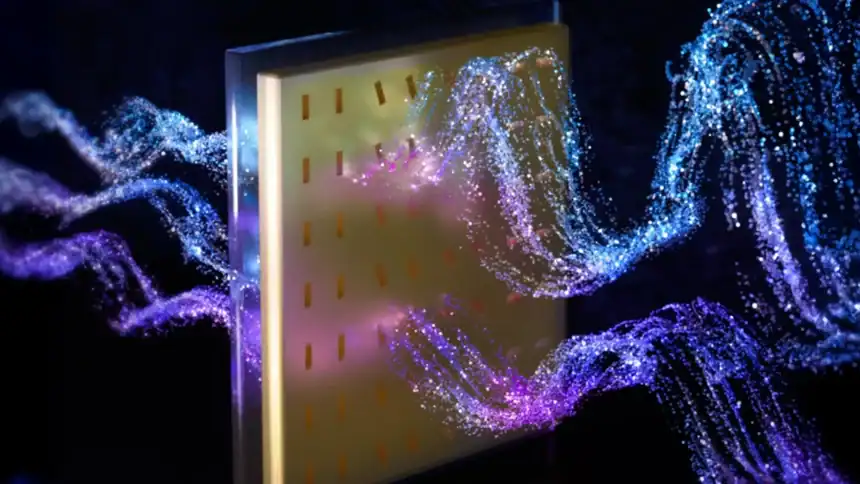
Start with a thin layer of gold on a glass chip. Then use focused ion beams to carve hundreds of extremely small slits into the metal. Each slit behaves like an artificial atom, what the team calls a meta-atom.
Put together, those meta-atoms form a crystal that has no natural counterpart. Light hitting the chip travels across the gold surface and interacts with the engineered structures. Adjust their size, shape and spacing precisely enough and you control how the whole thing responds.
The research was led by Omar S. Magaña-Loaiza, associate professor of physics, and his Quantum Photonics Group handled every stage in-house: the initial theory, the material design, the nanofabrication and the experimental testing.
"One of the most exciting parts of this project was realizing that we could build a material that does something nature doesn’t provide on its own. Seeing it work exactly as we predicted was incredibly rewarding," said Chenglong You, a former postdoctoral researcher now a professor at the University of Electronic Science and Technology of China.
A filter for statistics, not for color
Here’s the part that separates this from a clever fabrication demo.
Sunlight, laser light and fluorescent light are all photons. But the photons in each fluctuate and interact differently, and those small variations change how the light behaves at the quantum level. Telling them apart has generally demanded complicated equipment, detectors chilled to extremely low temperatures, and millions of individual measurements.
The metacrystal does the sorting itself. It doesn’t just react to familiar properties like color or intensity. It picks up subtle quantum distinctions in the incoming light and routes different quantum states down separate paths through the crystal.
"By engineering the distribution of meta-atoms in the plasmonic metacrystal, we can systematically dictate which quantum statistics are allowed to pass through the structure. So, our crystal essentially acts as a statistical filter on quantum states," said Riley B. Dawkins, who recently completed his Ph.D. and is joining the National Institute of Standards and Technology as an NRC Postdoctoral Research Associate.
Some of those routes let quantum states move through the material while their statistics change less. Statistics, in this context, are the defining characteristics that tell one quantum state from another.
"We call this robust transport," Magaña-Loaiza said. "These quantum states carry information. Our crystal can distinguish them and move them from one point to another in a robust way without requiring cryogenic cooling. That’s what opens the door to practical quantum technologies."
Physicists call the shared behavior involved here quantum coherence, and keeping it intact is among the hardest problems in quantum information science because contact with the surrounding environment destroys it fast. In the Nature paper, the team describes the metacrystal as the first room-temperature quantum material inherently sensitive to the quantum coherence of many-body systems.
New enough that they had to name it
The material departs far enough from conventional quantum materials that the researchers coined a term: the quantum statistical plasmonic metacrystal.
"For me, this wasn’t just a project — it was a collective effort built around the idea of creating something completely new in quantum technology," said Jannatul Ferdous, a graduate student in Magaña-Loaiza’s group. "What made it truly exciting was that we were not only creating a new class of room-temperature quantum material but also developing the theory to understand and control its behavior. Seeing this idea become an experimental reality was incredibly rewarding."
The crystal also turns out to produce structures the team calls quantum statistical bands. Conceptually they resemble the electronic band structures that govern how electricity moves through semiconductors, except these bands govern the movement and statistical behavior of quantum states of light.
Rearrange the meta-atoms and you choose which quantum states pass through untouched and which come out statistically altered.
That’s the broader claim the team is making. Researchers no longer have to depend entirely on stumbling across naturally occurring substances with useful properties. They can design materials that steer quantum states deliberately and predictably, which makes this a blueprint for a family of future materials rather than one isolated find.
What it might actually be good for
Room-temperature operation is what makes any of this relevant outside a physics department.
Materials along these lines might eventually carry fragile quantum information inside quantum computers without enormous cooling rigs attached. Cut or shrink the cryogenics and quantum devices get smaller, cheaper and easier to deploy. The same design principles could feed into more practical quantum communication networks and sensitive sensors.
Then there’s solar, which is where the team is pointing next.
Modern solar cells don’t convert all incoming sunlight into electricity. Some light gets trapped inside the material and turns into heat, which is energy the cell never delivers. A metacrystal that guides light along more stable pathways could keep some of that from being lost, leaving more of it available for conversion.
The plan is to build the metacrystal into solar cells and measure whether the share of sunlight converted into usable electrical energy goes up. That test hasn’t happened yet, and until it does, the solar angle is a hypothesis with a good mechanism behind it rather than a result.
The work was funded by the U.S. Department of Energy, Office of Basic Energy Sciences, Division of Materials Sciences and Engineering, under Award DE-SC0021069.