
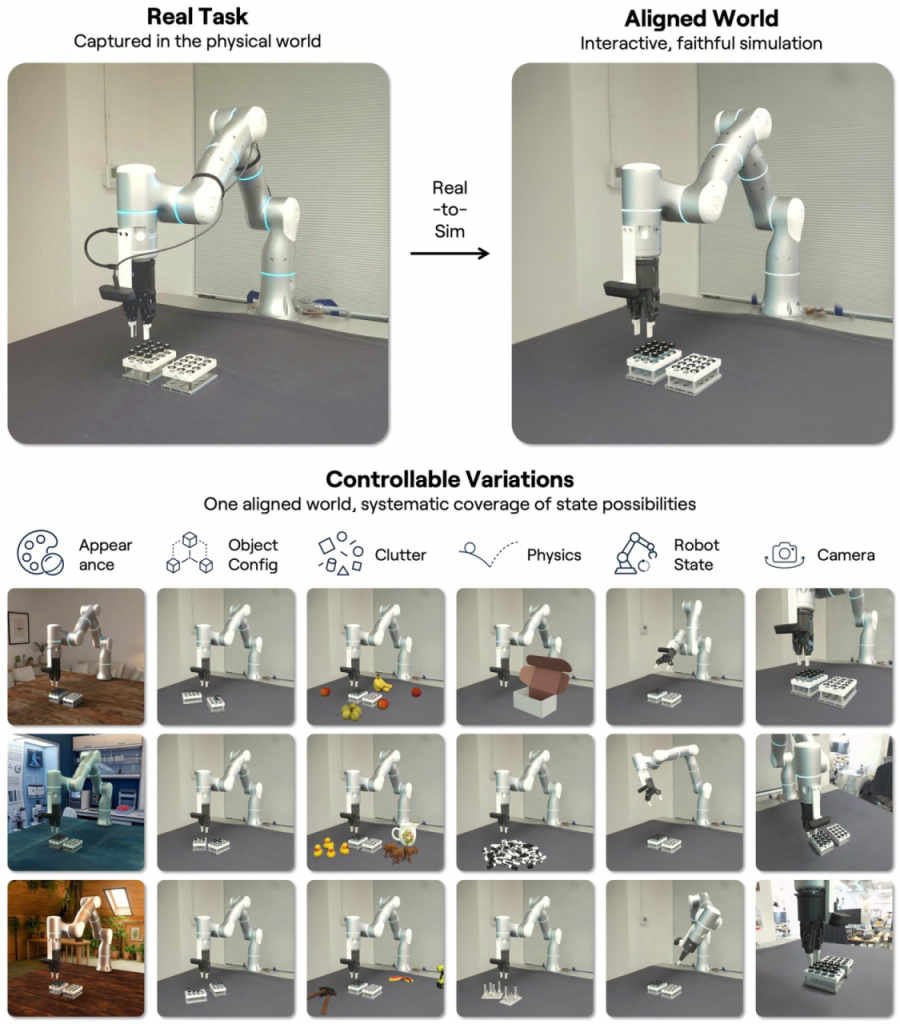
Feed World Labs‘ new simulation engine a single real robot task and it spits out thousands of variations of it, changing lighting, object position and count, the surrounding environment, physical properties like friction, and camera angle. The control models trained on that synthetic pile then run on real hardware for an hour at a stretch with nobody touching them.
That’s the claim from the startup Fei-Fei Li founded in 2024, and it’s a more specific claim than most robotics demos bother making.

The bottleneck isn’t the model
World Labs says the thing holding robot deployment back isn’t architecture. It’s the sheer volume of experience a robot needs before it works reliably.
Real-world data is expensive and hard to control. And online video, the fallback everyone reaches for, doesn’t systematically cover the full range of objects, physical conditions and failure states you’d need. You get a lot of footage of things going right and very little of things going wrong in instructive ways.
The company’s answer is an engine it calls Real-to-Sim-to-Real, or R2S2R. The technology came from SceniX, a startup World Labs acquired in July.
Rebuilding the room, not just photographing it
The engine captures robots, sensors, the environment and task demos, then rebuilds all of it as an interactive virtual world. The distinction World Labs draws is that the reconstruction doesn’t just look like the original, it behaves the same way physically. The company gets there by combining generative world models with task-oriented robot simulation.
Checking whether that’s true is the interesting part. World Labs runs the same action sequence in simulation and in reality side by side, then compares observations, object movements and outcomes.
The demonstrated tasks cover rigid, movable and deformable objects: cable routing, inserting an elastic cable end into a hole, packing a box with both hands. Deformable objects are where simulation usually falls apart, so it’s notable they’re in the list rather than absent from it.
An hour of running unsupervised, on four more platforms
Control models train in simulation and then transfer to real robots. One of the test platforms was ALOHA, the open-source dual-arm design out of Stanford that you operate by puppeteering with two smaller control arms. It costs a fraction of commercial systems and every blueprint is public, which is how it became the reference platform in robotics research.
According to World Labs, the models each ran for one hour across four additional robot platforms with no human intervention. The tasks included wrapping a power cord around a refrigerator with both hands, repositioning test tubes precisely, and separating thin objects like markers or pencils out of a dense jumble.
The system isn’t tied to a particular control model or robot type, the company says, so a world reconstructed once can be reused later for new models and different robots.
The cube handoff test is the one that matters
Here’s the argument underneath all of this. World Labs says robot development trails language models badly because evaluating control models has mostly meant testing on real hardware, which is slow and costly.
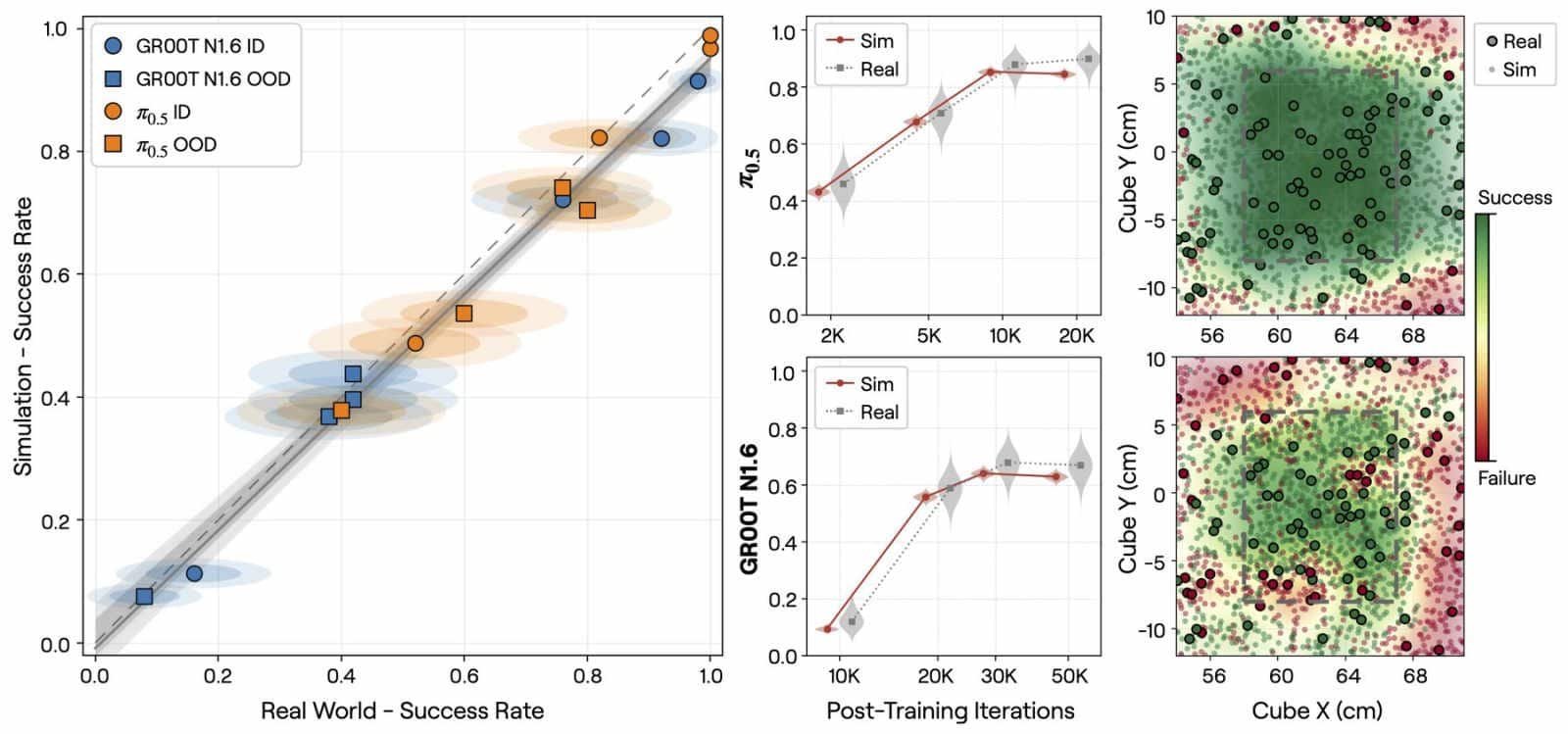
Its position is that a simulation doesn’t need to hit the same success rates as reality. It needs to answer the same questions: where does a model fail, which version is better, and do improvements carry over to the physical robot?
The team probed that with a two-handed cube handoff between the arms of an ALOHA robot. World Labs says the simulation reproduced the borderline cases, the ones where the robot barely grabs the cube by its edge, along with the matching failed attempts.
Across different model types, including GR00T N1.6 and π₀.₅, and across training stages, model rankings in simulation and reality stayed largely the same. That held for known cube positions and for previously unseen ones. Each checkpoint was evaluated with 2,000 simulated runs and 100 real ones.
The practical payoff: development teams can kill weak model versions in simulation and spend the expensive hardware tests on the candidates that survive.
Where this sits in the world model argument
World Labs connects the results to its own taxonomy of world models, where the simulator is the central piece because it turns a world into a place software agents can act in, learn in and be tested in. The company points at autonomous driving as precedent, noting that some successful Level 3 and Level 4 systems train on a mix of real and simulated data.
Its stated long-term goal: to scale the intelligence of robots, you have to scale the worlds in which they learn.
How well any of this transfers to more complex environments, other robot types and messier everyday situations is still open. The demos are controlled setups with cooperative objects.
That question sits inside a larger fight over what world models should even do in robotics. An international research team recently tried to nail down a uniform definition of a world model, drawing a hard line between world models and pure video generators.
World Action Models take a different route, tying predictions about the near future straight to control commands. World Labs keeps simulation and policy separate. A third approach, Orca, comes out of China and has a robot learn tasks purely by watching video, with no real motion data during training.
The money behind it
Li founded World Labs in 2024 to build models with spatial intelligence that understand the three-dimensional physical world. An early system generated walkable 3D environments from single photos. The company has since raised one billion dollars in venture capital to push its world models into robotics and science.
R2S2R is the first concrete thing that money has produced on the robotics side. If you’re evaluating it, the number to watch isn’t the thousands of generated variations. It’s whether the sim-versus-real model rankings hold up on tasks nobody picked in advance.