
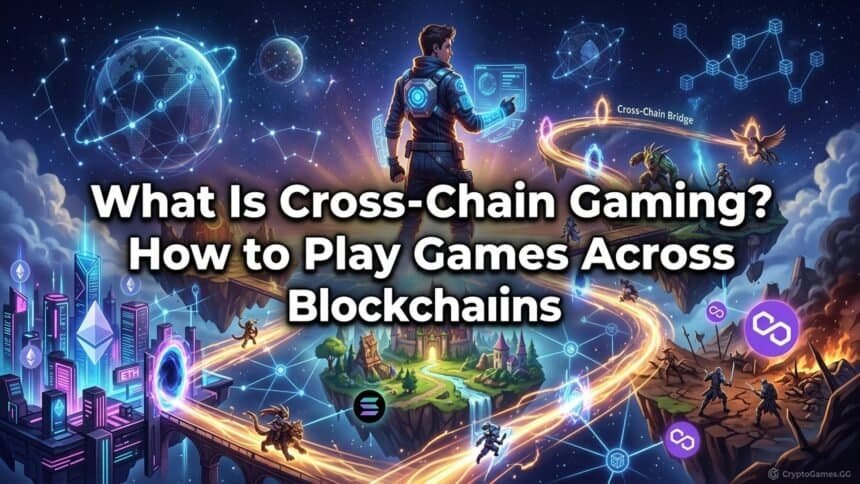
The biggest frustration in blockchain gaming is fragmentation. Your Gods Unchained cards are on Immutable X. Your Star Atlas ships are on Solana. Your Axie teams are on Ronin. They can’t talk to each other, can’t be traded across ecosystems, and require separate wallets and separate token management. Cross-chain gaming is the technical effort to fix this — and in 2026, it’s moved from theoretical roadmap feature to partial reality. This guide explains what cross-chain gaming is, how it works technically, which approaches are being used today, and what the timeline looks like for true interoperability.
Why Blockchain Gaming Is Fragmented
Different blockchain games run on different chains for legitimate reasons: Ethereum for security, Solana for speed, Immutable X for zero gaming fees, Ronin for Axie’s specific requirements, Polygon for Ethereum compatibility with lower costs. Each chain has real technical advantages for certain use cases. But the result is a fragmented ecosystem where an NFT on Ethereum cannot interact with a game on Solana, tokens earned on Ronin can’t be spent in an Immutable X game without multiple manual steps, and wallet management becomes a multi-chain juggling act.

For players, fragmentation means opportunity cost. Your blockchain gaming assets sit in separate silos. Your identity and reputation on one chain doesn’t transfer to another. Portfolio management requires multiple wallets, multiple transaction histories, and constant context switching between ecosystems.
For developers, fragmentation means choosing a chain early and accepting that players on other chains aren’t in their natural audience. This limits game reach and slows adoption — a game that could attract all blockchain gamers instead competes for a fraction based on chain preference.
What Cross-Chain Gaming Actually Means
Cross-chain gaming encompasses three distinct concepts that are often conflated:
Cross-chain asset portability: Moving an NFT from one blockchain to another. Your sword NFT minted on Polygon can be bridged to Immutable X to use in a different game. This requires bridge infrastructure and standards for NFT compatibility across chains.
Cross-chain interoperability: Games on different chains recognising the same assets or identity. An Ethereum wallet address establishes your identity across all EVM chains (MetaMask users experience this already — your address is the same on Ethereum and Polygon). Full interoperability would extend to non-EVM chains.
Cross-chain gameplay: Two players on different blockchains participating in the same game state. This is the most technically ambitious form — requiring either a neutral layer-0 blockchain coordinating both chains, or an off-chain game state that both chains can verify.
In 2026, cross-chain asset portability exists through bridges. Cross-chain interoperability is partial (EVM chains share address space, non-EVM chains don’t). True cross-chain gameplay is mostly theoretical with some early experiments.
How Cross-Chain Bridges Work
A bridge is the infrastructure that moves assets between blockchains. Understanding how bridges work is essential for any blockchain gamer who wants to move assets between gaming ecosystems.
The most common bridge mechanism is the lock-and-mint model. When you bridge an NFT from Ethereum to Polygon: the NFT gets locked in a bridge smart contract on Ethereum, a “wrapped” representation is minted on Polygon, and your Polygon wallet receives the wrapped version. The wrapped NFT functions identically to the original in Polygon games. When you bridge back, the wrapped version burns and the original unlocks on Ethereum.
The bridge contract is the security-critical component. The Ronin bridge hack of 2022 ($625 million stolen) was a bridge security failure — attackers compromised the private keys controlling the Ethereum-side bridge contract and drained it. See What Is the Ronin Network? Axie’s Gaming Blockchain Explained for the full incident analysis. The lesson: bridge security is weaker than either chain it connects, because bridge contracts are a concentrated attack target.
More secure bridge approaches include optimistic bridges (using fraud proofs and 7-day dispute periods), ZK bridges (using zero-knowledge proofs to verify cross-chain state, the same technology Immutable X uses), and liquidity-based bridges (liquidity providers facilitate cross-chain swaps rather than direct asset locking).
Cross-Chain Gaming Approaches in 2026
Layer-0 protocols (Polkadot, Cosmos, LayerZero) provide infrastructure for different blockchains to communicate and share messages. Games built on chains in the same layer-0 ecosystem can coordinate state and transfer assets natively rather than through external bridges. LayerZero’s omnichain protocol has seen the most blockchain gaming adoption, with several projects using it for cross-chain NFT transfers.
Shared game state with multi-chain asset support is the approach several games are exploring — running game logic on a neutral or off-chain layer while recognising NFTs from multiple chains as valid game assets. A game might accept assets from Ethereum, Polygon, and Immutable X, verifying ownership through each chain’s native verification and running the game itself on a fast off-chain state layer.
EVM equivalence already provides partial cross-chain gaming by making a single wallet address work across all Ethereum-compatible chains. MetaMask users can play Gods Unchained (Immutable zkEVM), Skyweaver (Polygon), and Ethereum mainnet games with the same address and private key. This isn’t true interoperability but eliminates much of the friction for EVM-only gamers.
NFT bridging programs — where specific game studios partner to allow assets from one game to appear in another across different chains — represent early cross-game interoperability. These are usually curated partnerships rather than open standards, but they demonstrate the concept works.
The Challenges: Why Interoperability Is Hard
Technical incompatibility: Ethereum and Solana have fundamentally different account models, smart contract languages, and NFT standards. An ERC-721 (Ethereum NFT) and an SPL token (Solana NFT) have different data structures. Bridging requires translation logic that may not preserve all metadata or functionality.
Security tradeoffs: Every bridge adds attack surface. More interconnected chains means more potential points of failure. The blockchain gaming space has already paid the cost of bridge security failures. Developers are cautious about adopting cross-chain solutions before they’re proven secure at scale.
Game balance: If assets from one game can transfer to another, game designers lose control over their in-game economies. A game balanced for assets with specific stat ranges breaks if higher-powered assets from another game can appear in it. Truly open cross-chain gaming requires either standardised asset stats or game designs that accommodate arbitrary external assets.
Incentive misalignment: Each chain has economic incentive to keep assets and activity on its own chain (transaction fees, ecosystem growth). Truly open cross-chain gaming reduces each chain’s captured value. The parties who would benefit most from interoperability (players) have less influence over the infrastructure than the chains and developers who benefit from walled gardens.
Which Games Support Cross-Chain Features Today?
Illuvium has the most ambitious cross-chain interoperability roadmap — plans to allow Illuvial NFTs to appear in third-party games beyond the Illuvium ecosystem. As of early 2026, this remains in development rather than fully shipped.
LayerZero-integrated games allow NFT bridging between multiple EVM chains. Several Immutable X and Polygon games have implemented LayerZero bridges for specific asset types, enabling players to move collections between chain ecosystems without using centralised bridge interfaces.
Star Atlas on Solana is exploring cross-chain asset recognition for partner projects, though Solana’s non-EVM architecture makes integration with Ethereum-based ecosystems more technically complex than EVM-to-EVM bridges.
What Is Immutable X? The Blockchain Built for Gaming for how ZK-rollup technology provides cross-chain security through Ethereum settlement. Best Crypto Gaming Wallets for managing multi-chain portfolios with the right wallet setup.
What Cross-Chain Gaming Will Look Like in 2027-2028
The trajectory in 2026 points toward: more standardised NFT metadata formats that enable cross-game asset recognition, more ZK-bridge infrastructure that provides bridge security comparable to the underlying chains, and more layer-0 gaming deployments that build cross-chain compatibility from the ground up rather than retrofitting it onto single-chain games.
Full true cross-chain gameplay — two players on different chains participating in the same real-time game state — remains 2-3 years away at optimistic estimates. The infrastructure for it exists in prototype form, but production security at scale requires more time.
Frequently Asked Questions
Can I use my Ethereum NFTs in Solana games?
Not directly. Bridging Ethereum NFTs to Solana requires conversion between different NFT standards and uses bridge infrastructure that adds security risk. A few specific partnerships have created bridges for particular asset types, but general Ethereum-to-Solana NFT portability doesn’t exist in 2026.
Is cross-chain gaming safe?
Chain-level security is strong on major blockchains. Bridge security is significantly weaker — bridges are the most common source of large-scale blockchain exploits. Use bridges only for necessary transfers and don’t store large amounts in bridge contracts longer than necessary for the transfer to complete.
What is the most interoperable blockchain gaming wallet?
MetaMask covers all EVM chains (Ethereum, Polygon, Immutable zkEVM, etc.) from a single address. Phantom covers Solana. No single wallet currently covers both Ethereum and Solana with native (non-bridged) asset management.
Conclusion
Cross-chain gaming in 2026 is a work in progress at the most important boundary — EVM to non-EVM interoperability. Within the EVM ecosystem, a MetaMask wallet already provides meaningful cross-chain gaming capability. Beyond it, bridges and layer-0 protocols provide partial solutions with real security tradeoffs. The direction is clear and the infrastructure is building, but complete interoperability where a player’s full gaming portfolio moves freely across all chains remains a 2027-2028 milestone at realistic timelines.