
In Brief:
- Nexpace opens the second season of MapleStory Vibe Camp on Aug. 18, again partnered with AI game creation platform Verse8.
- The announcement carried a date and a partner and little else. No prize pool, submission window or judging format has been disclosed.
- Season 1 paid out $59,580 in NXPC to 230 games in July, and Nexpace has been folding creator output into its MSU 2.0 push.
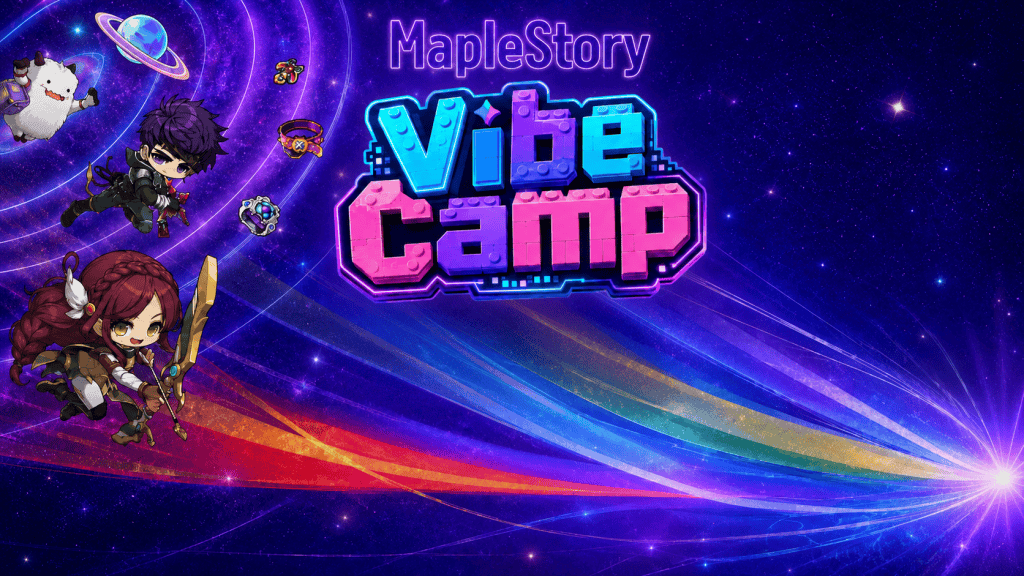
Nexpace will open MapleStory Vibe Camp Season 2 on Aug. 18, running it again with Verse8, the MapleStory Universe (official site) account said in a post on X.
That’s close to everything the company disclosed. There’s no prize pool, no submission deadline and no judging format yet. The post pointed readers to vibecamp.msu.io and added, “It’s worth the wait!”
Save the date: MapleStory Vibe Camp Season 2 is coming August 18, together with @Verse_Eight.
It's worth the wait!
The rest is here. Go see what's coming: https://vibecamp.msu.io
A follow-up had been flagged. After the first camp wrapped, Nexpace said Season 2 would be announced in the near future.
What the first camp produced
Season 1 ran June 8 to June 29 with a $60,000 prize pool in NXPC, open to builders worldwide. Participants worked inside MSU Space, the MapleStory environment Verse8 hosts, with access to more than 74,000 MapleStory IP assets and Verse8’s Agent 8 turning prompts into game code.
Creators built 693 MapleStory IP games over the three weeks, 435 of which went live. They sent more than 213,000 build commands to the AI. As of early July, roughly 1,250 builders were still active in MSU Space.
Entries went through two review rounds plus an anti-abuse check. Winners landed July 22: 230 games cleared the quality threshold and split $59,580 in NXPC across several categories. Fifty games picked up $500 Top Traffic awards based on recorded play counts.
Judges weighed player retention, community evaluations, scalability and how well an entry pulled in outside users. Genres ran to defense, idle, puzzle, RPG, simulation and roguelite.
Winners also get the “Winner’s Stack,” a support package covering game design consulting, business model design and engineering mentorship, with Nexpace handling publishing on the App Store, Google Play and Steam plus joint marketing through MapleStory channels. Nexpace said it is looking at pushing the Season 1 winners through outside distribution networks including YouTube Playables.
Where it fits
Vibe Camp was the first external collaboration under MSU 2.0, the expansion phase Nexpace started after MapleStory Universe’s first year of live operations. The stated goal is turning MapleStory from a closed IP into a programmable one, pairing licensing and settlement infrastructure with AI tools and community participation.
Sun Young Hwang, CEO of Nexpace, said the past year showed a large-scale game economy can operate on-chain and that “the next chapter is about expanding who participates in building it.” As AI lowers the barrier to game creation, Hwang said, the line between player and builder gets less fixed.
Kevin Lee, CEO of Verse8, said that “for decades, building with major gaming IPs has largely been limited to professional studios and approved partners.” Lee said Verse8 was “excited to help power the next wave of MapleStory builders.”
Verse8 and NXPC
Verse8 launched in July 2024 out of Planetarium Labs, developed with Jake Song. It reports 3.5 million monthly active users and 25,000 cumulative games. In March it raised $5 million from investors including Nexpace, Story Foundation, NEOWIZ and MARBLEX.
On the token side, Nexpace announced a buyback in May of up to $10 million worth of NXPC on the open market, executed in tranches over three months through an external partner and held in treasury. The company cited more than 850,000 wallets engaging with the platform over the prior year, about two-thirds of them spending NXPC monthly, and 49.1 million NXPC in ecosystem revenue, roughly $31 million.
Lee said the camp averaged 33 MapleStory IP games a day, which he called proof the platform “can serve as a foundation for an IP to expand into hundreds of games.” All five of the top Season 1 winners had never worked in the game industry.