

Five generations of Xbox games on one machine. That’s what a leaked Microsoft memo obtained by The Verge’s Tom Warren describes for Project Helix, the next Xbox: the original 2001 Xbox, the 2005 Xbox 360, the 2013 Xbox One, the 2020 Xbox Series, plus whatever new Helix titles arrive. It already plays PC games, too.
On paper that’s the largest library any home console has ever offered.

But the memo isn’t a spec sheet. It’s a pitch deck aimed at publishers, and that changes what this announcement is worth.
The missing puzzle pieces just clicked into place
We already knew Microsoft was bringing a limited sample of original Xbox games to PC. We already knew it was building a way to digitize your Xbox One and Xbox Series discs. Xbox 360 games are heading to PC as well, and the leaked document explicitly says those will run on Helix in addition to “Xbox PCs.”
The document also states that digitized Xbox One and Xbox Series discs can follow you to “any Xbox device.” Helix qualifies.
So the pieces connect. What they don’t add up to is the kind of backward compatibility you’re used to.
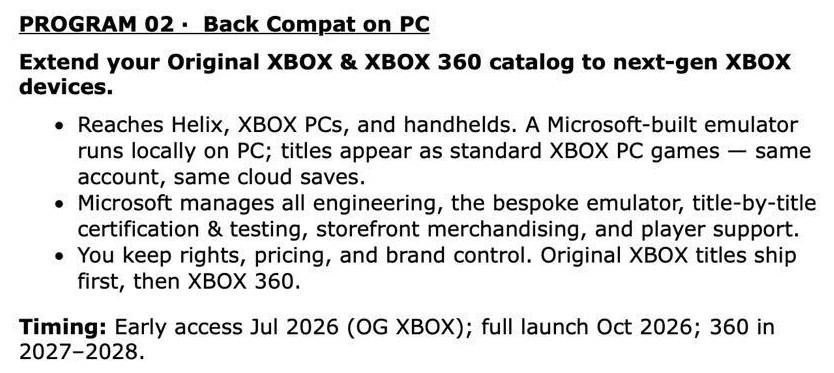
This isn’t sliding a PS4 disc into a PS5
Start with the obvious problem: Helix may not have a disc drive at all. Last we heard, Microsoft hadn’t decided.
Then there’s the permission layer. Every form of backward compatibility here appears to run through publisher approval, and the memo exists specifically to talk those publishers into it.
One section is titled “Why publishers win.” The win, mostly, is selling old games as if they were new again.
The carrot Microsoft is dangling
Even disc-to-digital conversion, where a publisher presumably doesn’t book a fresh sale, comes with a sweetener. “Turn physical disc owners into digital customers,” Microsoft writes.
Translation: Johnny might not buy another copy of Mass Effect from EA, but maybe he buys five future games digitally instead.
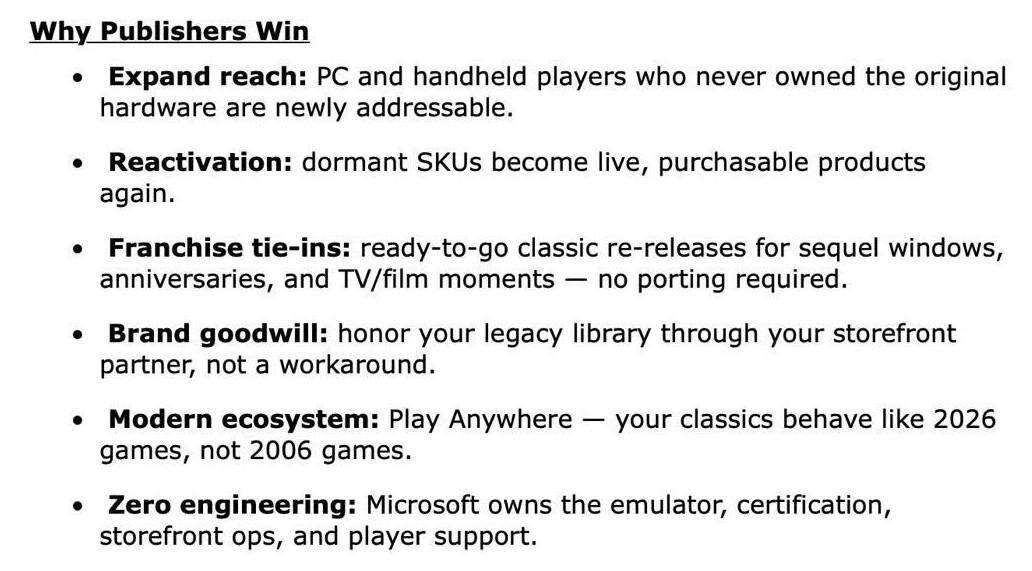
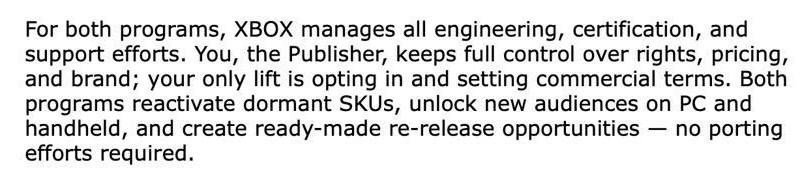
I’m not knocking the incentive. It’s good that Microsoft has something to offer, because by the sound of it the company can’t even convert Xbox discs to digital without publisher buy-in. Microsoft does say publishers don’t have to do any work for disc-to-digital, writing “Publisher action: none required.” But it also says early on that both new game preservation programs require opt-in.
Original Xbox and 360 games need approval title by title
Here the memo gets blunt. Publishers grant permission for each and every game, set the price, and decide whether it lands in Xbox Game Pass or sells standalone only.
None of that is shocking. When Nvidia’s GeForce Now let people stream PC games they’d already bought without asking first, publishers pushed back hard enough that the service went opt-in.
GeForce Now is also the cautionary tale. Permissions get revoked. Rights issues surface. Some publishers never opt certain games in at all.
Microsoft’s own track record is the tell
Microsoft is a giant publisher itself, though it has fewer studios after the Xbox “reset” that’s costing thousands of employees their jobs.
And its appetite for this work has limits. Between 2015 and 2021, Microsoft got roughly a quarter of the Xbox 360 library and around 6 percent of the original Xbox library running on Xbox One and Xbox Series consoles. Then it stopped.
Ownership doesn’t guarantee permanence either. Multiple Forza Horizon games have been delisted, including the backward compatible version of the original, because the developer only secured temporary licenses for content inside them. Licensed cars expire. Licensed music expires.
What I actually want out of this
Xbox 360 games with cloud saves, possibly as soon as 2027, sounds genuinely good. I want it to work.
I also think both Xbox and PlayStation are going to need something like it. In the age of RAMageddon and the post-disc era, these consoles have a price tag problem to solve.
For Sony, my bet on the answer is handheld. For Microsoft, it might be one Xbox that plays them all. That outcome doesn’t sit with Microsoft’s engineers, though. It sits with a few dozen publishing executives reading a memo about why they win.