
In Brief:
- Retium opened its public testnet and released the Retium Wallet at wallet.retium.org as the first stage of the rollout.
- Testers claim test $RTM from a faucet, with access tied to a verified Discord account rather than a wallet address or IP.
- It’s the first time outsiders can touch the PrimeMesh architecture and Proof of Math consensus the team has been describing since its foundation phase.
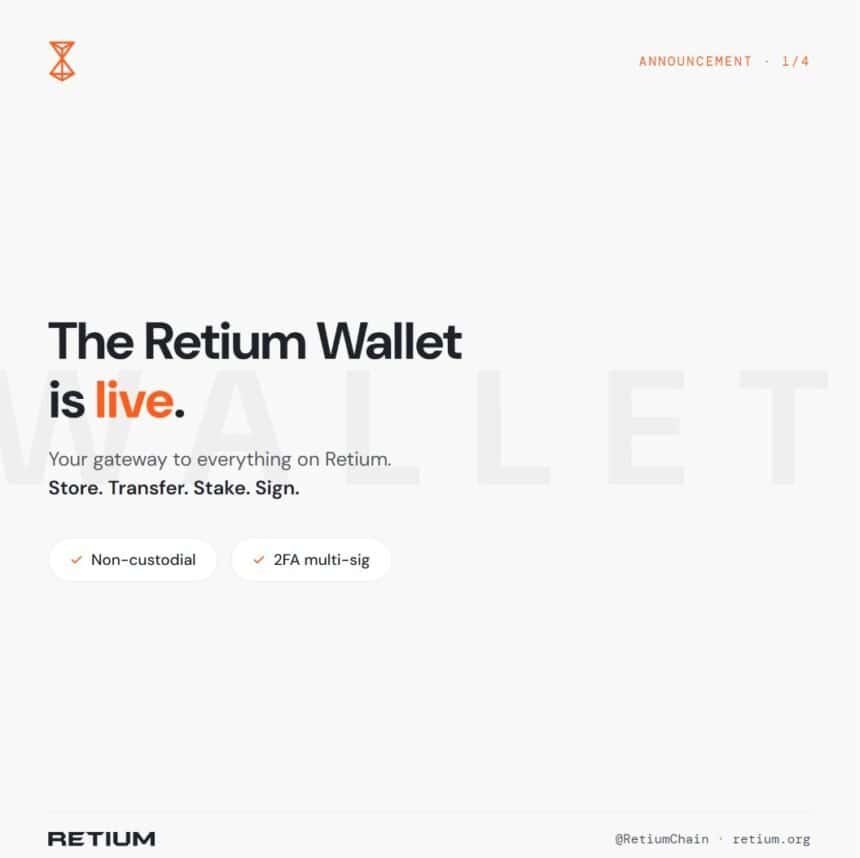
Retium opened its public testnet, releasing the Retium Wallet as the first stage of the rollout. The wallet is live at wallet.retium.org.
“Retium Public Testnet is now open,” the project said in a post on X. “The first stage, Retium Wallet gives users direct access to the network and lays the foundation for everything we are building next.”

Retium Public Testnet is now open.
The first stage, Retium Wallet gives users direct access to the network and lays the foundation for everything we are building next. Come and explore it at http://wallet.retium.org@RetiumView on X ↗
The release lands on schedule. Retium’s roadmap listed the wallet and public testnet faucet for August 2026, with stage one scheduled for Aug. 1. Earlier posts had put the window as early as the end of July.
Discord gating on the faucet
Testers claim test $RTM to start using the network. Access runs through a verified Discord account instead of a wallet address or IP, which the team said is meant to block mass wallet creation and faucet farming.
The same gate lets the team run one-on-one support through dedicated tickets. Participants join the official Discord and work up to the “newbie” role before they can claim. The server has roughly 15,977 members.
What testers are connecting to
Retium is a Layer-1 written from scratch in Rust. Block IDs come from prime number factorization under what the team calls Prime Number Linking Architecture: block 15 factors to 3 x 5, so it links to blocks 3 and 5.
Between three and 20 blocks stay open at once, processing transactions in parallel rather than in a queue. There’s no mempool. Transactions route straight to open blocks, which Retium claims makes front-running and MEV extraction impossible by design. Fees are weighted by transaction size rather than bid.
Validation splits into three roles. Workers check that each transaction is legitimate and safe to execute. Keepers recompute the same mathematical result from the same inputs, and a majority agreement gives consensus. Five Suits per sealed block coordinate finality and broadcast the verdict that marks a block HardFinal.
The team says forks are mathematically impossible under the model, with no mining race, no leader election and no longest-chain rule.
Those claims haven’t been independently checked. The 3,000 to 5,000 transactions per second figure Retium cites is a projection, not a mainnet-verified number, and no public security audit has been announced. A whitepaper sits at docs.retium.org.
The gaming angle
Retium pitches WASM smart contracts as a way for developers to embed chain logic directly into games. Gaming sits alongside DeFi, DAOs, NFTs and real-world assets in the project’s target list, and the fifth phase of its roadmap covers expansion into RWA, gaming, AI and enterprise applications.
Token terms
Supply is fixed at 1,000,000,000 RTM with 18 decimals. Nothing mints past genesis, and Retium says no admin key, governance vote or emergency function can raise the cap. RTM covers transaction fees, staking, contract interactions and value transfer.
A second asset, $Pie, exists only through staking. Stake RTM and the protocol mints an equal amount of Pie 1:1. Unstake and the Pie burns, returning the RTM.
The project states there’s no team allocation, no early-validator supply and no insider discounts, with every RTM entering circulation through what it calls the Safehouse on the same terms for everyone. Development, security, ecosystem grants and operations are funded by a Treasury share of 5.5% of all transaction fees.
Retium finalized that model in a post last month. “Retium’s business model and tokenomics are now finalised. After careful review, we deliberately chose not to follow the typical crypto path of discounted token sales, insider allocations, and speculation. Instead, our focus is on building a strong, sustainable foundation for” adoption by users, businesses, developers, financial institutions and AI applications, the team said.
An explorer beta is scheduled for October 2026, followed by a public $RTM coin reservation round, a developer SDK testnet release in December 2026 and a validator testnet in March 2027. A private vesting round is open now, and the team said an AFSL licence application is being finalized.
The name comes from “rete,” Latin for net, mesh or network.